Green and Blue in the Desert

A common side-blotched lizards perches on a rock in front of the green of an out-of-focus saguaro

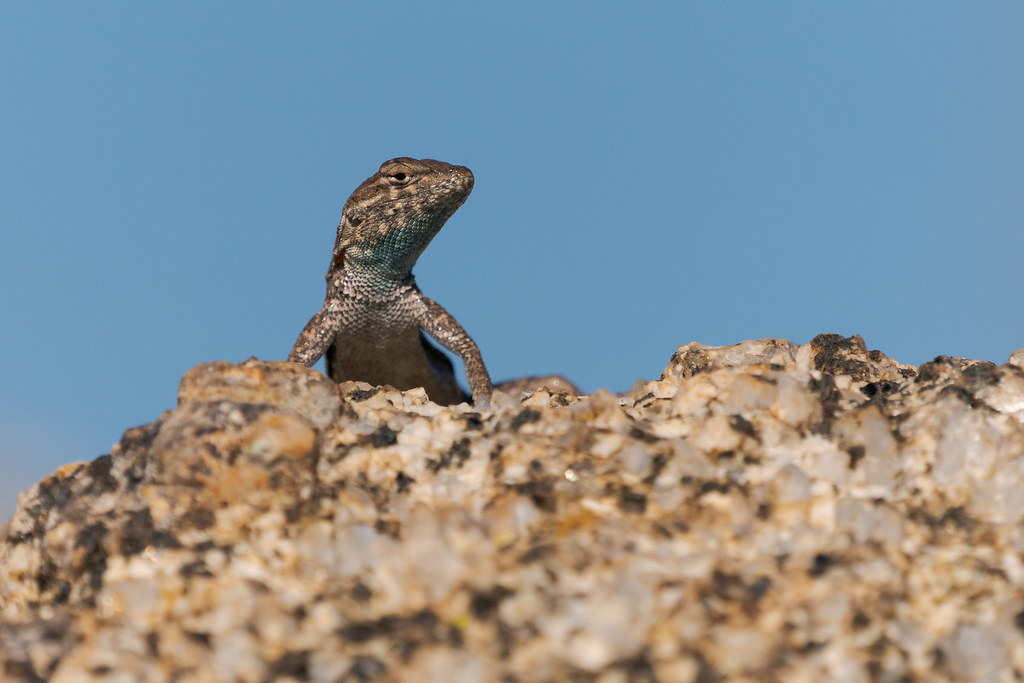
I was sitting below this little common side-blotched lizard, shooting up at it against a blue sky (below), when I realized if I moved the camera slightly I could shift the background to green courtesy of a massive saguaro standing behind it. There is green in the desert, not the ubiquitous saturated greens of the forests of the Northwest but a soft, muted green, always in the saguaros and palo verdes but on many more plants now that the summer monsoons have arrived.

Blue is easy to find in the skies of the desert but some lizards, especially the males, may have blue throats or sides or blue speckled throughout their scales. Blue too is the skin around the eyes of adult white-winged and mourning doves. All of these blues can be seen where I photographed this lizard at The Amphitheater in McDowell Sonoran Preserve, a rock formation on the Cholla Mountain Loop Trail that is one of my favorite places to hike.

A common side-blotched lizards perches on a rock in front of blue skies

The Valley of the Sun

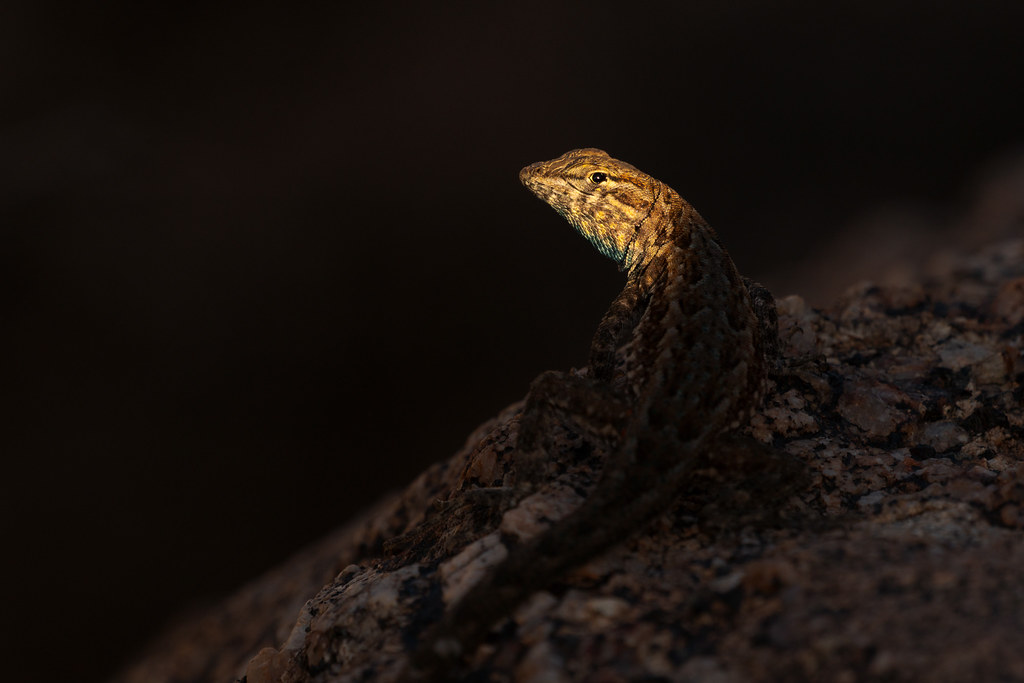
A common side-blotched lizard all in shadow save for its head along the Rustler Trail in McDowell Sonoran Preserve in Scottsdale, Arizona

In the Valley of the Sun, when you get the first rays of light depends on when the rising sun clears any mountains to the east. This scene played out in miniature early one morning when I found this common side-blotched lizard completely in shadow until it turned its head into a shaft of light that had just cleared the rock behind it.

Turning Rocks Into Lizards

A desert spiny lizard peeks out from behind a rock on the Rustler Trail in McDowell Sonoran Preserve in Scottsdale, Arizona

As I hike the pattern recognition part of my brain is constantly scanning for objects that might be wildlife even though they often turn out not to be. I spent a summer in Florida in the mid-90’s and was delighted by the many alligators there, it took years after we moved to Oregon for that part of my brain to stop trying to identify possible alligators when I hiked in marshland. In Yellowstone on a gravel road there was a large rock in the distance that in the periphery resembled a bear. I loved that road and drove it a number of times and as I approached that spot, I’d tell myself not to be fooled even for an instant by what I came to call Bear Rock. But every time the pattern recognition would kick in for a fraction of a second and say “Hey is that a …” before the rest of my brain would reply “I just told you it wasn’t going to be a bear!”

Here in the Sonoran Desert I am fooled by cholla skeletons that look like rattlesnakes, twigs like small lizards, granite protuberances like large lizards. I try to use my mental powers to turn rocks into lizards but usually I fail, rock stays rock. But sometimes I succeed and the rock comes to life, such as this beautiful desert spiny lizard on the Rustler Trail in McDowell Sonoran Preserve. One success is worth a thousand misses.

Shields Up! Red Alert!

A coiled western diamondback rattlesnake with its head up underneath a dead tree on the Sidewinder Trail at Phoenix Sonoran Preserve in Phoenix, Arizona

Today was meant to be a test of my knee and turned into a test of my heart when this western diamondback rattlesnake and I scared the living daylights out of each other.

Yesterday I made my triumphant return to the trails after a self-imposed two week absence to allow a sore left knee to heal, choosing a flat hike I know well at McDowell Sonoran Preserve. Since that went well, as well as a morning and evening swim later in the day, this morning I decided to try some new-to-me trails at Phoenix Sonoran Preserve. I did some research and the Ocotillo Trail looked fairly flat, with an easy return on a paved trail if my knee started acting up but also an option for some elevation changes on the Sidewinder and Ridgeback Trails if my knee felt up to it.

As I neared the point where the Ocotillo met the Sidewinder, my knee felt fine so I put my camera into my camera bag and brought out my trekking poles. My goal was to use the poles both for stability and to shorten my steps on any inclines to avoid stretching my legs more than necessary. As the trail immediately started to climb I knew I could turn around at the first hint of trouble and take an easier route back.

And that’s when I heard a noise right in front of me that nearly stopped my heart. The rattler was right beside the trail, coiled with its head up and mouth open, rattle shaking. I backed off immediately and it relaxed, slowly moving a few feet over and hiding under a dead tree. As you can see from the first picture while not in a full striking position its head was still up and prepared to strike if need be, but quickly lowered its head to its body, then even fully relaxed when it realized I wasn’t going to approach.

I was sorry for startling it so but thankful our encounter ended peacefully. With my new camera bag I was able to get the camera out quickly and take a few pictures. I wasn’t expecting to see a rattler so close to the trail since I had passed many mountain bikers who would have come past, with a couple more passing me a few minutes later, but perhaps it had just crossed the trail or maybe it didn’t mind the quickly passing bikes.

Happy to report that after a 7.5 mile hike on a hot and humid summer morning, both the knee and the heart were doing fine. My eyes could use some work though, to better see beneath my feet.
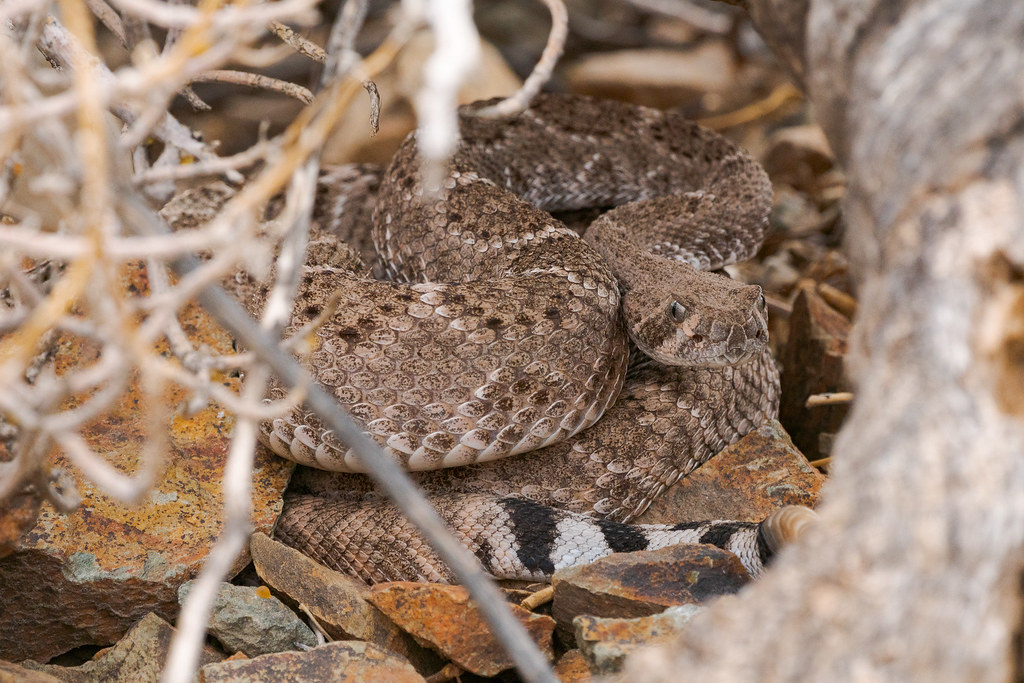

A coiled western diamondback rattlesnake with its head lowered underneath a dead tree on the Sidewinder Trail at Phoenix Sonoran Preserve in Phoenix, Arizona

Joy at My Feet

A common side-blotched lizard perches on a rock beside the Sidewinder Trail in Phoenix Sonoran Preserve in Phoenix, Arizona

If I could tell myself at 10 years old that in 40 years I’d be working on things in space and hiking with lizards at my feet, I suspect he’d wonder what took me so long to get here. I’ll tell him about a place called Oregon and I think he’ll understand, and if not he soon will. I don’t think I would have been ready for the desert without spending so long in the Pacific Northwest first and will always be grateful for my time there. I’ve been hiking as much as I can since arriving in Arizona, I love seeing lizards in the desert even though usually they’re scurrying out of sight as I walk past. Sometimes I get a longer look such as this past weekend with this common side-blotched lizard on the Sidewinder Trail in Phoenix Sonoran Preserve, my first hike outside of Scottsdale.

Learning to See in the Desert

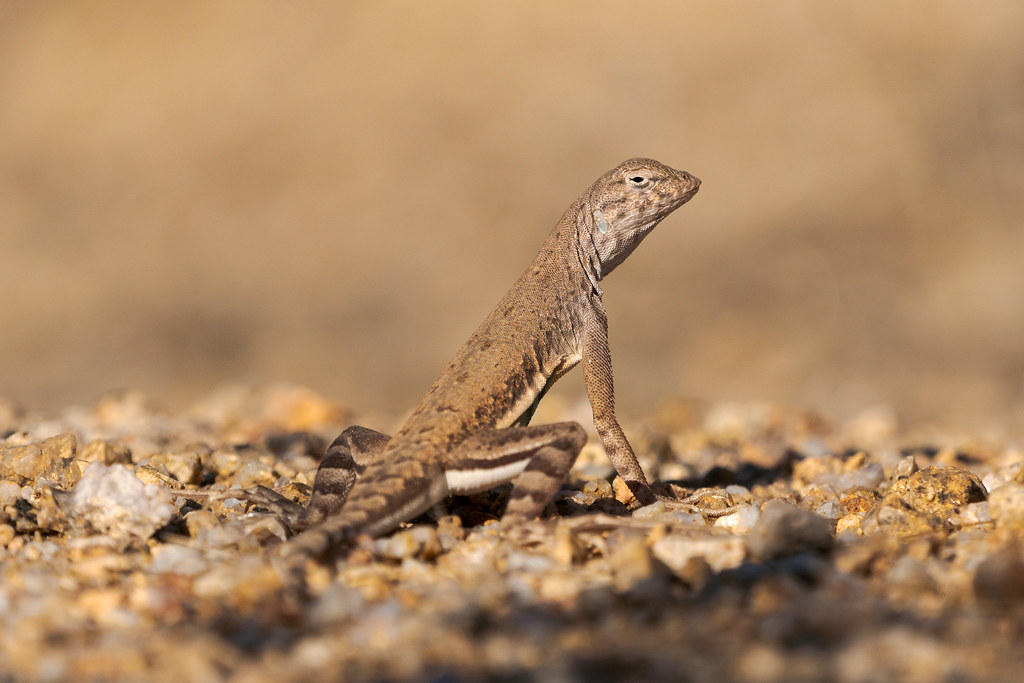
A zebra-tailed desert on the ground near The Amphitheater in McDowell Sonoran Preserve

Hiking in the desert feels both normal and unfamiliar. I know so much more about this unique environment than when we moved here but I have so much more to learn. As I hike the trails I’m well aware that the animals are living their lives perhaps not far from where I’m walking but even for those within my sight I wonder how many I actually see. I’m still developing eyes for the desert.

I am making progress, each hike is an opportunity both to look and to see. While taking a water break near the Amphitheater I spotted what I thought might be a lizard in the scrub and walked closer with my camera, almost turning around on a couple of occasions when I became convinced it must be a stick or bit of dried cactus. Thankfully I kept going and discovered this lovely zebra-tailed lizard. It happened again this morning, out on the Rustler Trail I thought I saw another zebra-tail in the middle of the trail so I slowed my approach, but repeatedly doubted myself until I was close enough to remove all doubt.

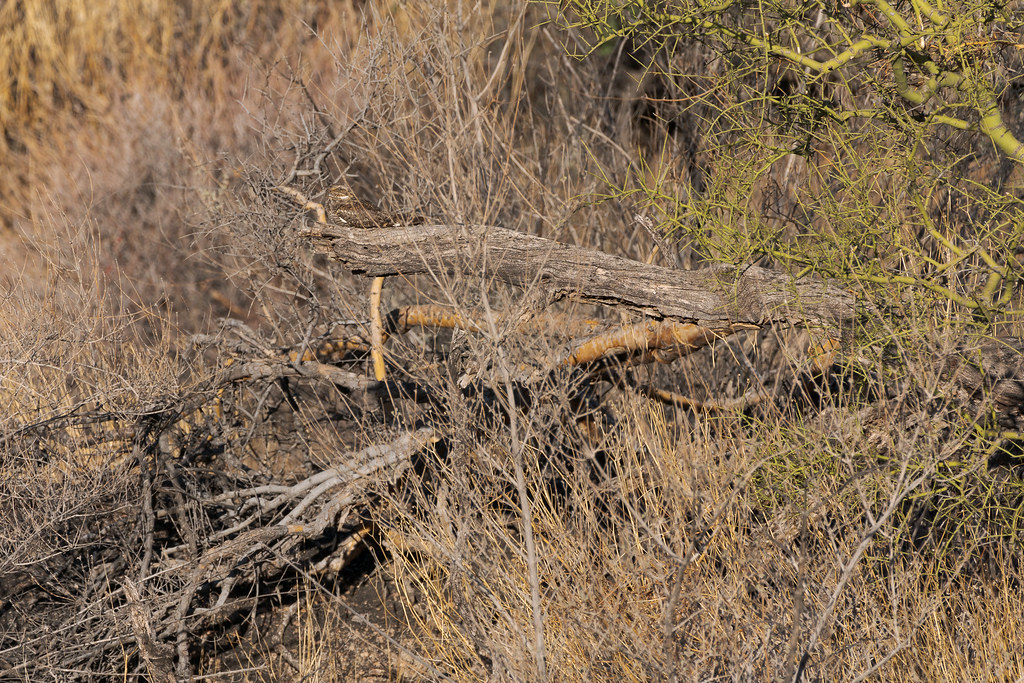
Sometimes though I think I could live here for decades and still not see what lies before me. The only reason I saw the lesser nighthawk below was that I stopped for a water break and it flew towards a nearby rock before seeing me and settling down further off on this fallen tree, hidden in plain sight. I’ve seen them flying low over the desert numerous times but I now wonder how many I’ve passed that were settled in for the morning.

A lesser nighthawk is barely visible as it rests on a fallen tree in McDowell Sonoran Preserve

A Rhubarb With Scales

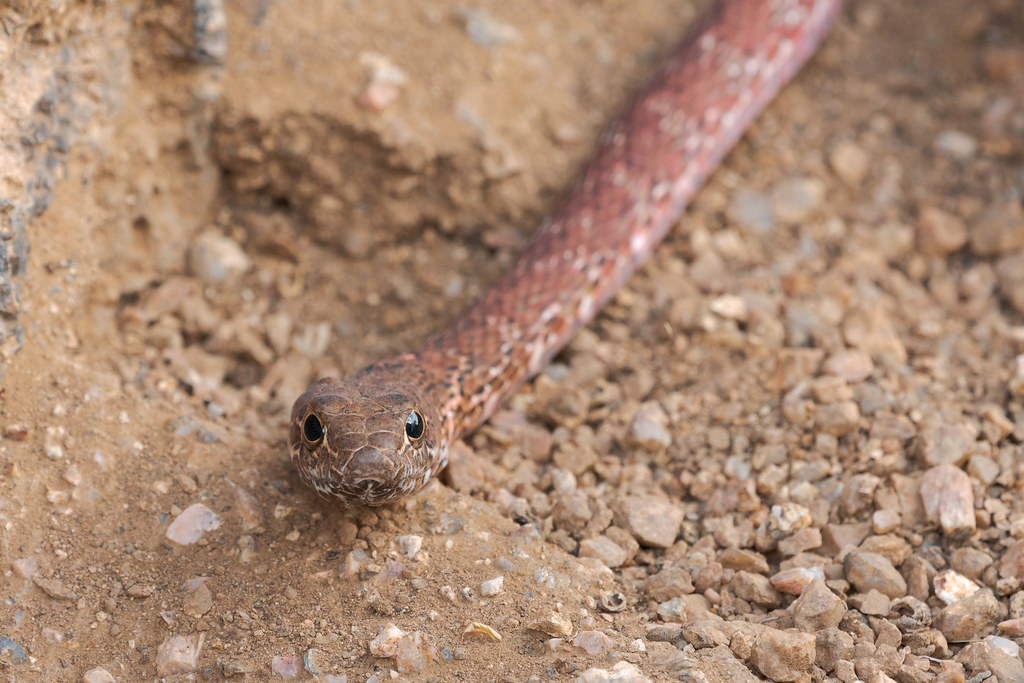
The middle of a coachwhip (red racer)

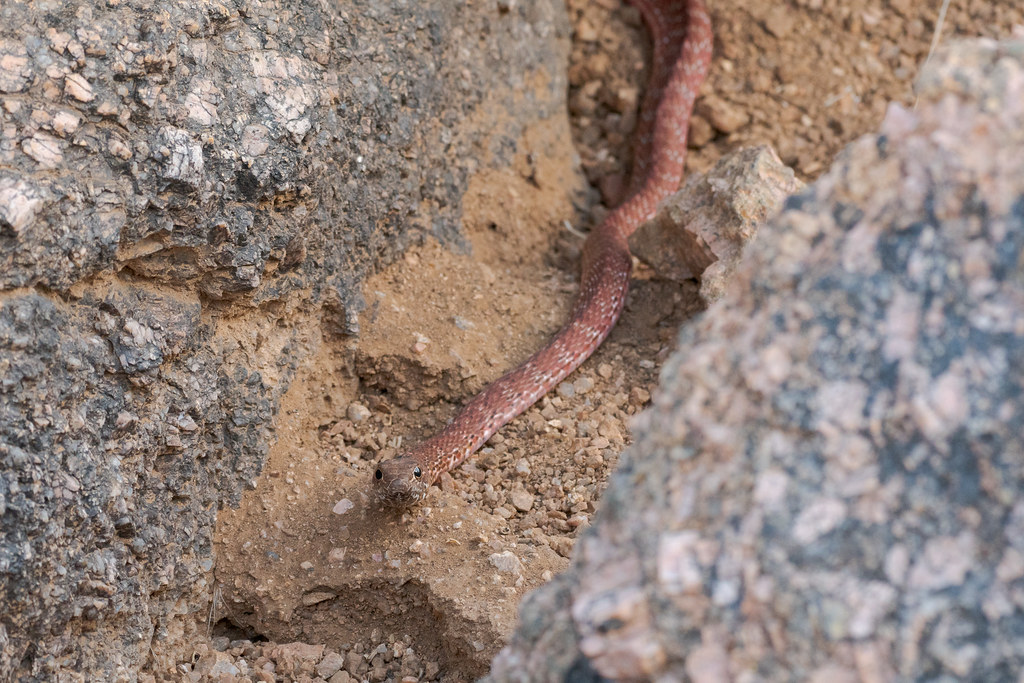
I arrived early on the Vaquero Trail to look for the antelope squirrels but as I approached from below I could see none were out on the rocks. I took a breakfast break and while drinking some water I noticed what reminded me of rhubarb back in the rocks. I hadn’t seen any plant like that in the desert but then I still have so much to learn. In case it was a discarded rubber gasket I went in for a closer look in case it was trash I should take with me, and that’s when I realized my rhubarb had scales.

The face of a red racer variety of coachwhip

I believe this is a coachwhip (of the red racer variety) and I have to say I was rather stunned to see it, I had no idea such a lovely creature existed! While not venomous it is a threat to many of the small animals of the desert and I hope the bulge I saw in its middle wasn’t one of my squirrels! Since it wasn’t coiled up and resting I took some pictures and then backed off in case it wanted to move, it didn’t while I finished my water and food break but after a mountain bike came whizzing past I looked up and the snake was gone.

The red racer variety of coachwhip between rocks

It Rains in Heaven

It Rains in Heaven

Moving to Arizona I hoped to see a Gila monster though I knew they are rarely seen in the desert. Moving from Oregon I was sad to leave behind the rain for it is also rarely seen in the desert. Sometimes you get lucky. Up before sunrise I drove to the preserve as rain fell from darkened skies. I wondered if the trails would be crowded with people just as excited about hiking in the wet (they weren’t), even as I feared I wouldn’t see many reptiles (I didn’t, I only saw two all morning). But what two!

After getting to watch a rattlesnake in the rain at my leisure, after circling Cholla Mountain I approached the spot I had seen a Gila monster before and thought it would be funny if there was a glitch in the matrix and I saw one there again.

I didn’t. I had to take a few steps further.

As I scanned the rocks above me as the rain pounded down, there it was, my monster. Unlike with the snake my time with the Gila monster was altogether too brief. I had to move quickly but I was able to get some pictures of two of my loves together, this magnificent lizard and this glorious rain.

Diamond in the Rain

A close-up view of a western diamondback rattlesnake in the rain on the Chuckwagon Trail in McDowell Sonoran Preserve in Scottsdale, Arizona on June 16, 2018. Original: _DSC5237.ARW

It was raining in the desert. Even better, I was out in it. So it was already a glorious morning when I found a jewel beside the trail, a diamond if a smaller one. I put my new Sony telephoto lens to good use although I hadn’t expected to expose it to the rain quite so early in its life as it was only my third time hiking with it.

The rattlesnake was comfortable with my presence as the rain poured down and I wasn’t about to let such an opportunity pass me by, new lens or not. My preference when shooting wildlife is for them to be aware of me and to feel in control of the encounter, usually to minimize the stress to them but in this case also to minimize the stress to me. Beautiful as they are western diamondbacks are both our largest and most common rattlesnake and worthy of respect.

As the rain intensified I noticed it calmly started sweeping its head across its coiled body. At first I thought it might be a sign it wanted to move so I backed even further off but the behavior continued, a slow graceful sweep of its head across its body. I resumed looking through the telephoto lens and realized its mouth was moving, like it was swallowing, and I wondered if it was drinking raindrops from its scales? Or cleaning them?

In the close-up shot you can see water drops on its head and even its eyes. Near the front of its head you can see one of its nostrils, and in between and below the nostril and eyes you can see the heat-sensing pit that allows them to hunt at night. After taking a break for water and food I continued on my way. May all our encounters be so peaceful little one, I pray we never meet in anger.

A western diamondback rattlesnake is coiled up in the rain beside the Chuckwagon Trail in McDowell Sonoran Preserve in Scottsdale, Arizona on June 16, 2018. Original: _DSC5263.ARW

A Tale of No Tail

A common side-blotched lizard with a missing tail clings to a mound of dirt on Brown's Ranch Road in the McDowell Sonoran Preserve in Scottsdale, Arizona

This lovely little creature is a common side-blotched lizard. It doesn’t get a fun name like the Gila monster but the name is descriptive enough, they are both common and have a dark spot right behind their front legs (making them one of the few lizards I can currently identify). What you might notice once you can get past its beauty is that it is missing its tail. Many lizards can shed their tails if a predator grabs hold of it, remarkable in and of itself, but even more remarkably the tail can regrow (potentially with different coloration than the original).