Turnabout is Fair Play

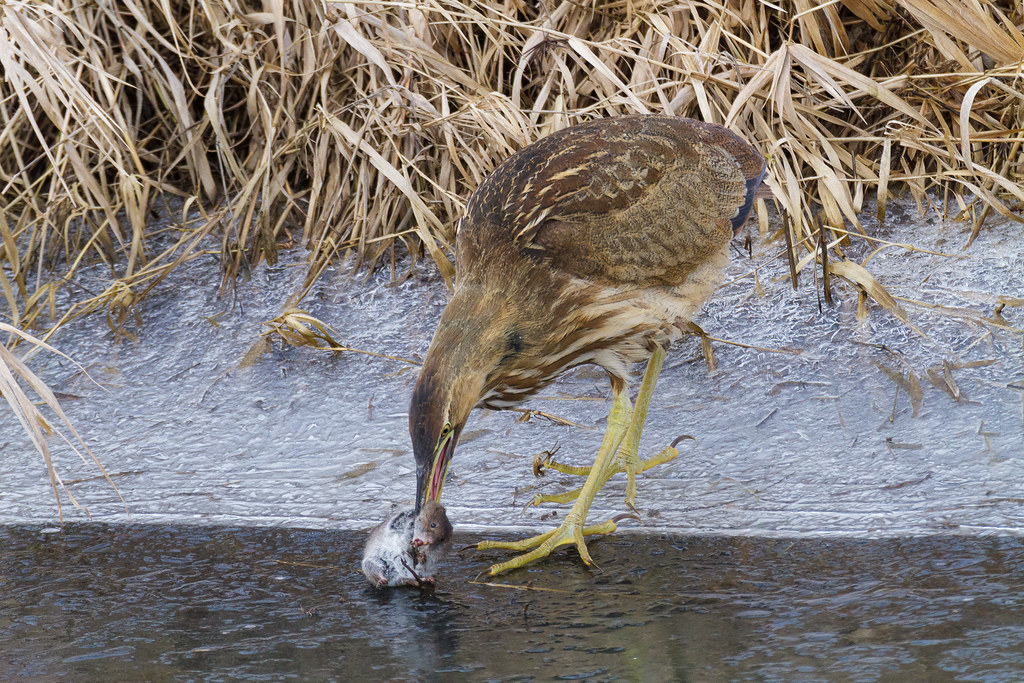
A close-up view of an American bittern catching a bullfrog at Ridgefield National Wildlife Refuge

One of the stories at Ridgefield this winter has been the American bitterns which have been putting on a show at several spots around the auto tour during many of my visits. I’ve always been on the lookout for bitterns so I’m not sure why I’ve had so much success watching them hunt lately, although it may have something to do with the fact that I spent far more time at the refuge over the Christmas break than I usually do. This bittern was mostly snagging small fish as it worked the channel beside Rest Lake, but at one point it stopped and started wiggling its neck side to side and then struck into the middle of the channel, bringing up this bullfrog. Bullfrogs themselves are voracious predators and, since they aren’t native to the Northwest, have combined with habitat loss to cause problems for some of our natives. This little bittern was doing its part to turn the tables and win one for the home team.

Falco

A female American kestrel perched on a plant at Ridgefield National Wildlife Refuge

There are a handful of true falcons that typically breed in North America, all belonging to the genus Falco, with the smallest being the American kestrel (falco sparverius). The kestrels at Ridgefield are pretty wary and often won’t stay perched if you pass on the auto tour, and probably for good reason, as there are a number of other birds of prey that share these hunting grounds that dwarf the little falcons in size.

This lovely female was a ways off the road and stayed still for a few pictures before she took to the skies again to resume the hunt.

Synchronized Preening

An adult American beaver preens and shows off its large flat tail in the early morning light at Ridgefield National Wildlife Refuge in May 2006

Early one morning on Mother’s Day, I stopped along the auto tour at Ridgefield to watch wood ducks in a quiet channel. A sudden dark form in the water caught my attention, I hoped for a beaver but knew it was more likely a nutria, the most commonly seen of the large rodents. Muskrat frequent the area as well but it was too large to be a muskrat.

My first impression from the size and shape of the head was that it probably was a beaver. There was little doubt left when its large, round form emerged onto the far bank, and no doubt remained when its broad flat tail finally came out of the water. I was feeling pretty blessed, watching the beaver preening, when a second dark shape swam onto the scene. To my delight, a smaller beaver climbed up onto the bank next to the large one and began grooming itself before finally snuggling up to the larger beaver.

Upon getting home, I learned that there is no difference in size between beaver sexes, but that the young often stay with the parents for the first couple of years, so this is most likely parent and child. I don’t know the sex of the older beaver, but given the day, I’d like to think they were mother and child.

An adult and a juvenile American beaver preen side-by-side in the early morning light at Ridgefield National Wildlife Refuge in May 2006

Ooomm-ka-chooom

An American bittern calls out at Ridgefield National Wildlife Refuge on May 10, 2009. Original: _MG_4365.CR2

It amuses me that a bird that tries so hard not to be seen has a call that can be heard from so far away. The bittern has a distinctive ooomm-ka-chooom call that is one of my favorite sounds of the marsh, it reminds me more of a gurgling swamp than a bird. In this picture it has spread its throat out, sending out its call across the marsh.

📷: Canon 20D | Canon 500mm f/4 | Canon 1.4X
🗓️: May 10, 2009

No Blackberry Breakfast

Close-up of juvenile red-tailed hawk's face looking down

There’s an invasive species of blackberry that has spread across the Northwest and is prevalent at Ridgefield. A variety of animals will use the berries as food or the thickets as cover, but this young hawk was using it as a place to listen for breakfast, every sound from below drawing its eyes downward. It didn’t end up catching anything, at least not during our time together.

Gold Reward

A common yellowthroat perches in cattails at Ridgefield National Wildlife Refuge

The yellowthroats weren’t staying still for very long, so even if I got a clear view of one I had to move quickly. For a few seconds this male flew into the middle of the cattails, not so high as to draw the ire of the blackbirds. His eye was obscured by the cattail in front nearly the entire time, but he stuck his head out far enough for me to get one picture before he flew off.

My favorite picture of the day.

Baby Please Don’t Go

A male American goldfinch perches on a cattail at Ridgefield National Wildlife Refuge

I sat in my car at Ridgefield for hours hoping in vain to photograph migrating common yellowthroats. I was getting ready to leave when this male goldfinch and a female flew into the cattails. I only had time for a few quick pictures of the male before a territorial red-winged blackbird flew in to chase off the intruders. So happy to get a look, however brief, of goldfinches I decided to stick around a while longer and was rewarded with nice views of a male yellowthroat as well.

Oh Ridgefield!

A common yellowthroat looks out from a patch of cattails at Ridgefield National Wildlife Refuge

I got up at 5am this morning with yellow on my mind.

Like last week, I hoped to photograph yellow-headed blackbirds up at Ridgefield National Wildlife Refuge. However, the yellowheads were staying more in the interior of the marsh this week. I can’t say that I blame them, last week the red-winged blackbirds were harassing them a bit but this week they would mob the yellowheads mercilessly every time they came to the edge.

Even so, my morning did turn out to be about yellow — not from blackbirds but yellowthroats and goldfinches. After spending six hours at the refuge last week, today I stayed for ten hours. I would have stayed longer but the weather was supposed to be sunny and I had only played to stay for a couple of hours and hadn’t brought enough food and water.

Remind me to ignore the weatherman next time.

I took far fewer pictures than last week but my quarry was more elusive. The yellowthroats were staying mostly out of sight, and when they did pop up to sing they were either chased by the redwings or by other competing yellowthroats. I was ready to call it a day and about to start the car to leave when a goldfinch popped into view. That convinced me to wait a while longer but again was ready to leave when this male yellowthroat finally appeared.

I wish the out-of-focus cattail wasn’t in front of the cattail that he is actually clinging to, but I still think it’s a cute picture. I got a few others I was happy with so stay tuned for those, plus a few goldfinch pictures.