The Blackbird

A male red-winged blackbird sings while sitting atop a cattail

I didn’t leave the house for the first few days after Emma died, apart from taking Ellie on her walks, but by the fourth day I decided to head up to Ridgefield for a little bit. I made a note in my journal when I got there that my heart wasn’t in it and I didn’t know if I’d stay more than a few minutes, but spending some time with this blackbird lifted my spirits and I stayed for several hours. I stopped at South Quigley Lake when I saw him sitting on a cattail that was taller than all the others around it, as it gave me a lovely view of a lovely bird. I didn’t expect him to stay long, they are often flitting to and fro in the marsh, but he stayed there for a long while, preening and stretching and occasionally singing.
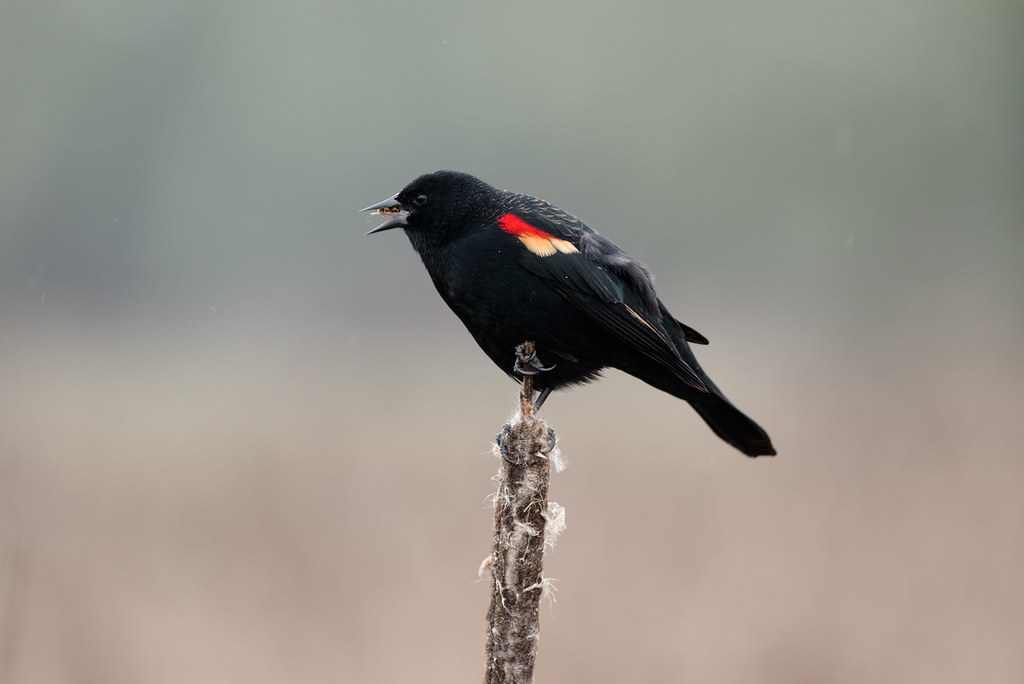
A male red-winged blackbird pins an insect to the roof of its mouth with its tongue

I’m well aware that some of my favorite creatures eat some of my favorite creatures in order to survive, I spent much of the Christmas break watching herons and egrets and bitterns eat all manner of small creatures near the shoreline, but I was reeling from Emma’s death and not in the mood to see something die. I deliberately avoided watching those predators on this visit but I was reminded of how often life and death are on display at the refuge when the blackbird suddenly leaned down and plucked an insect from the cattail. He has it pinned to the roof of his mouth with his tongue, headfirst, and is about to swallow it.

A male red-winged blackbird stretches while sitting atop a cattail

The auto tour takes a sharp left turn after you pass South Quigley Lake and you can see a blue car right behind the blackbird in this photo. There was less traffic though than I expected and so for the most part it was a peaceful afternoon, just what I wanted. While watching the blackbird a couple of times I spotted a Virginia rail darting through the cattails, and later I saw a doe and fawn of the Columbian white-tailed deer that were transplanted to the refuge (the doe was transplanted, the fawn was born at the refuge). It was nice to see sandhill cranes and a river otter too.

Soon thereafter Sam would get sick, and then some of the other pets, and then we got Trixie, and I’ve been busy enough and tired enough that I haven’t gone back out since. Now that Trixie is all settled in, I’ll be returning to the refuge before too long.
Lunch for One

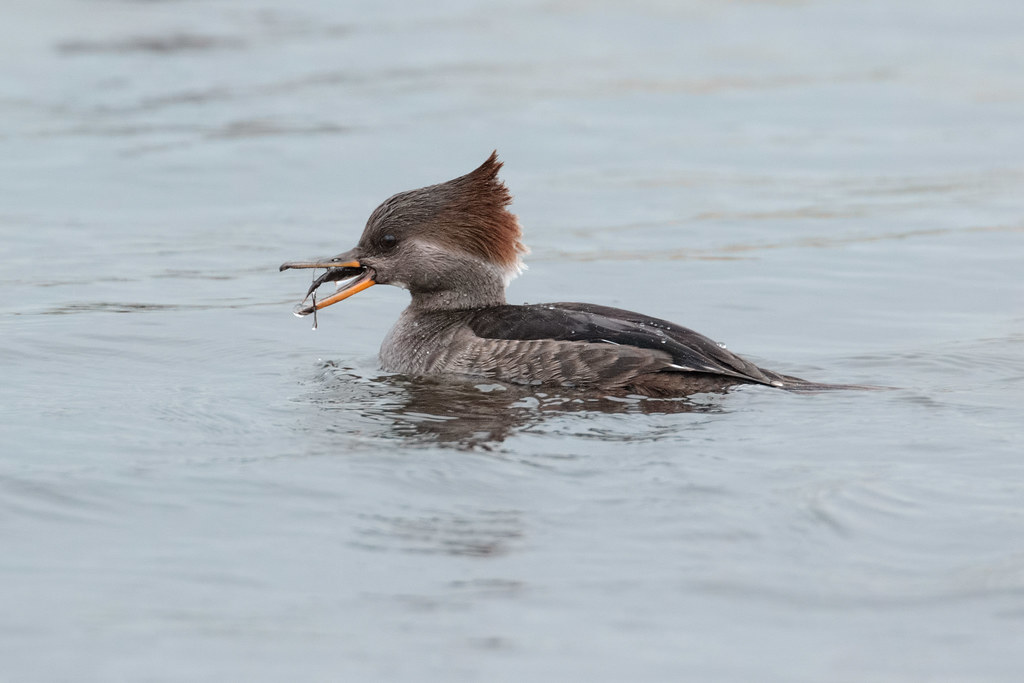
A female hooded merganser swallows a fish

A hooded merganser swallows a fish she just caught in the shallows of Long Lake. She’s swimming away not from me but rather the other mergansers in her group who would be more than happy at the chance for a free meal. Once she surfaces with the fish she’s got to get it oriented head-first, lengthwise down her long thin bill, and toss it back and swallow it. The still squirming fish sometimes gets dropped even when alone, much less in a crowd, so a little private space is always welcome.

An End to Hibernation

End of Hibernation: The Dunk

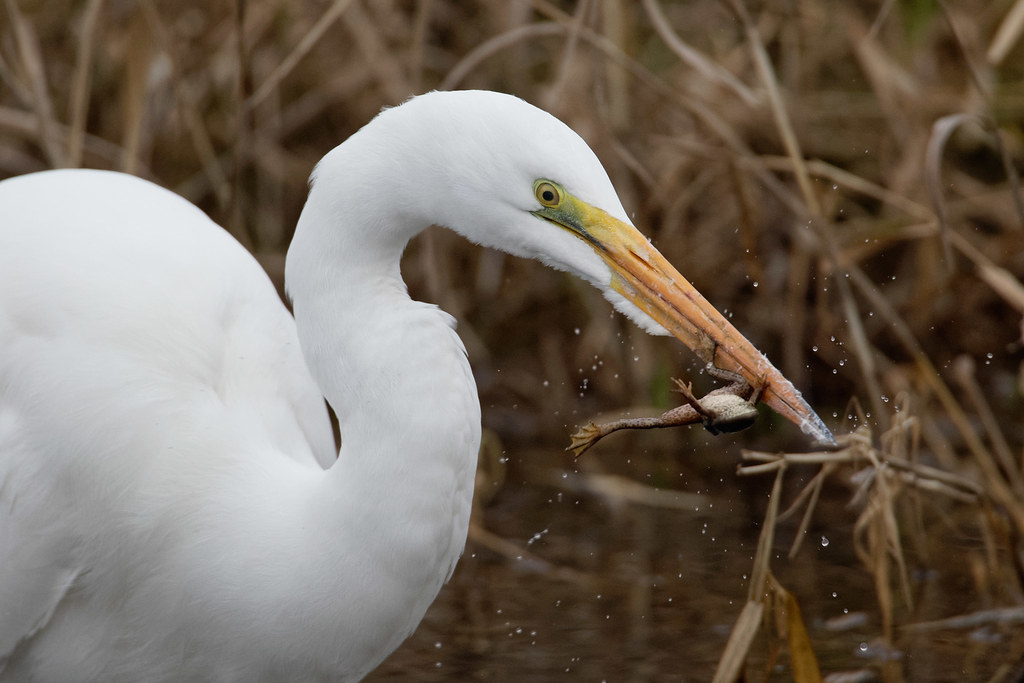
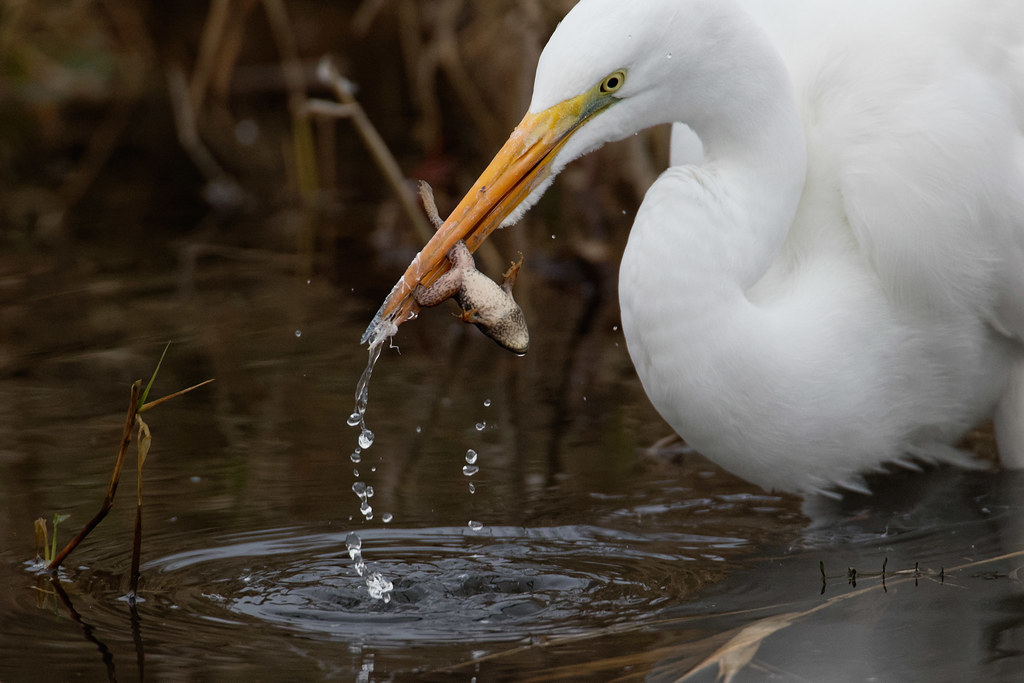
Bullfrogs hibernate during the winter so their metabolism slows significantly and they aren’t very active but they don’t bury themselves in the mud the way a turtle might. Many bullfrogs at Ridgefield found their hibernation cut short this winter by the herons and egrets and bitterns that worked the shallow channels and ponds of the refuge.

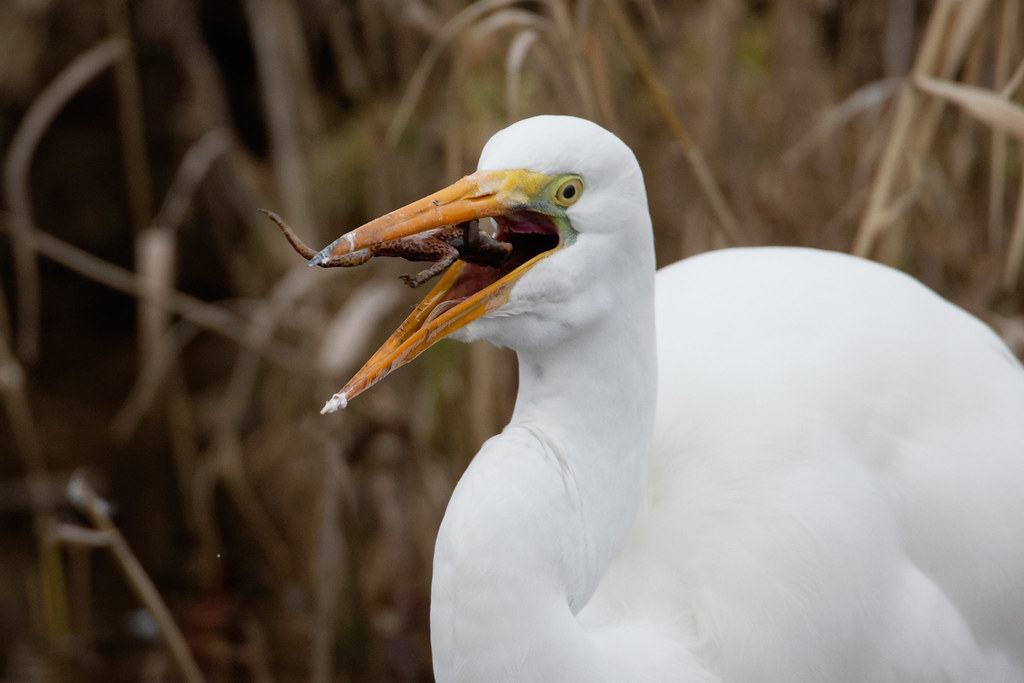
This egret in particular was just walking up and down one such channel, avoiding a great blue heron doing the same, striking at bullfrog after bullfrog, following a familiar process between catching the frog and eating it. First, the frog would be dunked quickly into the water, as shown above. Next, the egret would spin the frog rapidly, presumably causing massive internal injuries to the frog, as shown in the following two pictures. In the first picture, the egret has closed the nictitating membrane in its eyes, a transparent third eyelid that protects the eye from damage while still allowing the egret to see, as water spins off the frog and its clawed feet flail about, while in the second picture the membrane has been retracted.

End of Hibernation: Spin Cycle No. 1

End of Hibernation: Spin Cycle No. 2

Then the egret would toss the frog into the air, catching it in a different place on its body, and either repeat the process again if it caught it by a leg, or perhaps crush it in its beak if it caught it by the body. This would happen multiple times until I gather the frog had died or given up fighting, although with the egret constantly keeping the frog moving it was hard to tell exactly when or if the frog itself stopped moving.

End of Hibernation: Throw & Catch

The final step was to position the frog head first in its beak and swallow it whole. Bullfrogs are voracious predators and, as they aren’t native to the area, have had a big impact on some of the other small creatures in the ponds and sloughs. However I’ve seen the bullfrogs themselves become prey for the larger predators of the refuge, including not just egrets and herons and bitterns but otters, raccoons, and grebes.

End of Hibernation: The End

Drizzle

A young elk bull grazes in a meadow in Grand Teton National Park

A young elk bull grazes in a meadow on a rainy fall day in Grand Teton National Park in 2006. He was eating with another young bull, both keeping a watch on the nearby harem of a mature bull.

It’s a little hard to see the rain in the picture at this resolution, but I had just purchased my 500mm lens before this trip and while the lens has weather sealing, I was still a little nervous about exposing it to the elements. Nine years later it’s been through a lot more rain and is still going strong.

A Mouthful of Bullfrog

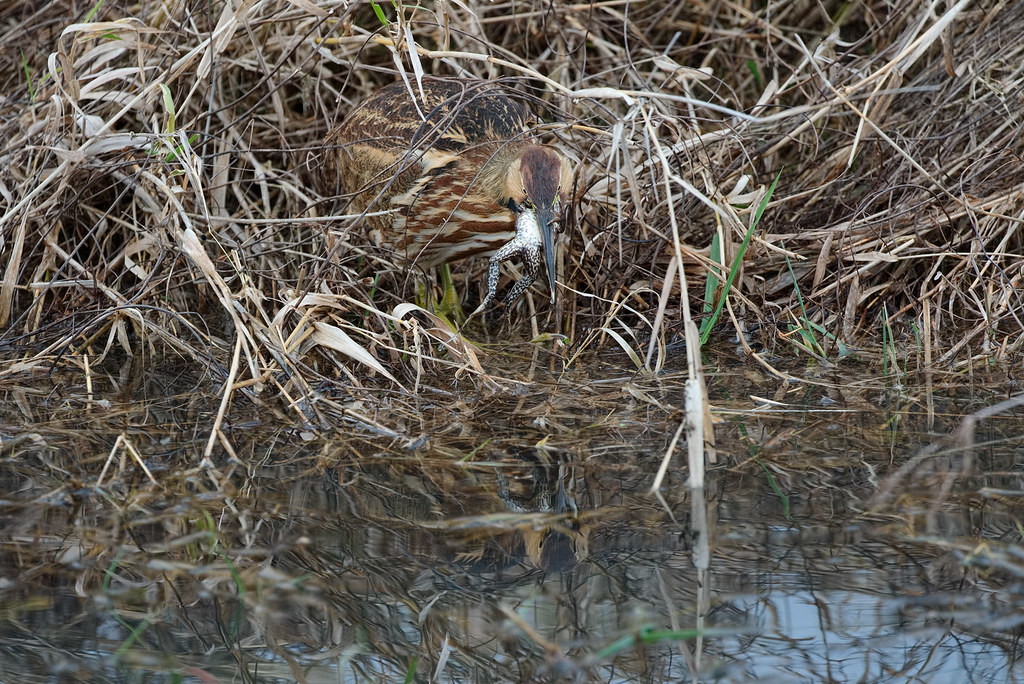
An American bittern prepares holds a large bullfrog in its mouth

Normally I’m pretty good at spotting bitterns at Ridgefield but I saw them on only three out of ten visits to the refuge over the Christmas break. I worried I was losing my touch until I found this bittern on Christmas Eve slowly working the channel beside Rest Lake. I suspect the real reason I haven’t seen as many this year is that the grasses in this area, normally my best spot for seeing them, have been cut lower in places, eliminating cover for both the bitterns and the animals they are hoping to catch.

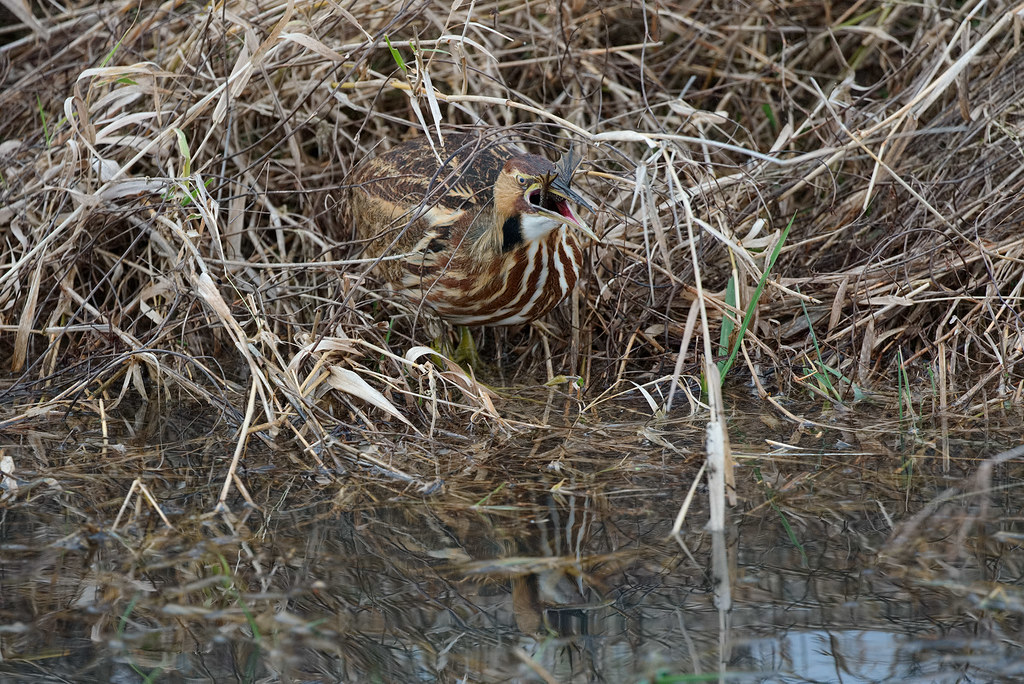
The bittern snagged a large bullfrog from the water as you can see in the top picture. In the picture below the bittern has swallowed most of the frog with only the rear feet sticking out of its mouth. The bittern has protected its eyes from the frog’s claws with a nictitating membrane, a common tactic in the chaos of swallowing something that doesn’t want to be swallowed.

An American bittern swallows a large bullfrog

Water

A great egret eats an American bullfrog in the rain at Ridgefield National Wildlife Refuge

In 2001 I bought what at the time was my most expensive lens, Canon’s 100-400mm lens. Since then it’s gone with me on every hike and nearly every trip and been one of my most treasured lenses. However the image stabilization system needs repair but I haven’t sent it in as I was hesitant to spend much money on a lens that could benefit from a modern re-design.

To my great delight, Canon finally brought out a new 100-400 lens and I pre-ordered the day of the announcement. It arrived on Friday so Saturday morning I opened it up and took it to my favorite refuge to try it out. One of the nice new features is that the lens has some weatherproofing, which I got to test with my very first pictures when I encountered this egret in the pouring rain. The egret was on the passenger’s side of the car so I slid over, stuck the lens out the window into the rain, and had just got the exposure and focus set when the egret struck into the water, pulling out this small bullfrog.

I meant to frame a little looser but in my haste to even get the shot I didn’t keep the camera quite level, so I rotated and cropped in post. Still I was pleased that with the zoom I was able to pull back and show a bit of the world these animals live in. The egret with its long featherless legs is built to wade in shallow water like this, able to hunt along the water’s edge, looking for frogs and fish in the water and frogs and voles on the land.

I’ve always loved photographing in the rain, especially to show how animals still have to go out into the rain to live their lives, and I’m thankful my favorite hiking lens now can as well.

Patience, Grasshopper

A Townsend's chipmunk eats a grasshopper in Mount Rainier National Park

I spent my first full day on this visit to Mount Rainier hiking the Skyline Trail and its various offshoots. While I had seen grouse and marmots, based on previous visits I was a bit surprised to not see more wildlife than I did. What I saw most were grasshoppers which were constantly hopping about the trails, many crushed underfoot from the mass of hikers on the previous day.

At the end of a hard day’s hiking I went back up to see if any marmots were out in the biggest colony near the trail, as they had been quite active the previous evening, but was sorry to see that they had all called it a day. I hiked a little further and was delighted to find this Townsend’s chipmunk eating what I assumed were some seeds on a boulder near the trail.

I was a little confused when, after watching it eat for some time, it started coming straight toward me. But it just grabbed some flattened grasshoppers near my shoes and hopped back up onto its boulder and ate them. It was then that I realized that most of this little section of the trail had been cleared of grasshoppers, and when I reviewed my pictures I understood why.

After a while it came back towards me, but this time hopped right between my legs and continued on down the trail. It had its dinner, and as the light faded, it was time for mine.

Crossing Over

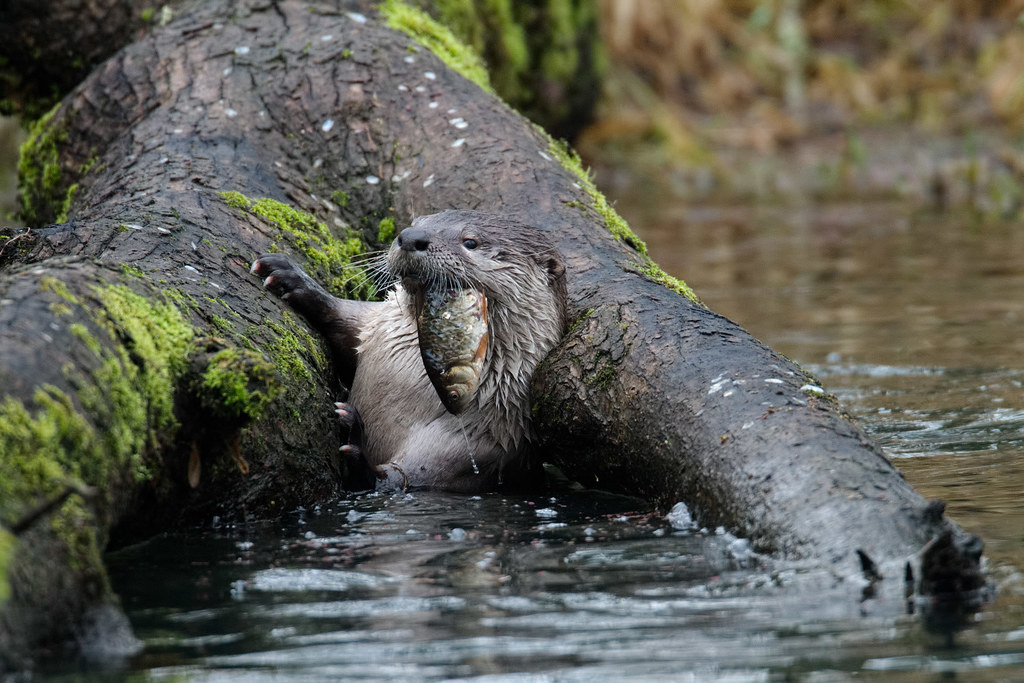
A river otter surfaces with a fish in its mouth

When car shopping a couple of years ago, I only considered cars where it was easy to cross from the driver’s seat to the passenger’s seat. I was specifically thinking of situations like this at the auto tour at my local refuge, where I saw a family of river otters to the right of the car and the best views were from the passenger seat. Thankfully crossing over is easy to do in the Subaru Crosstrek we bought and I was able to watch the otters for quite a while as they groomed and played and ate. I was struck by how, even in the midst of vigorous play, the siblings would catch a fish when the opportunity presented itself and enjoy a quick snack before resuming play.