
This bighorn sheep calf was getting rather large to still be nursing so it had to get down on its knees to be able to drink its mother’s milk. The mother only let it nurse for a short time before moving on.
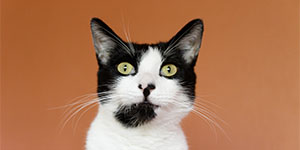
Scratcher of heads, rubber of bellies
This bighorn sheep calf was getting rather large to still be nursing so it had to get down on its knees to be able to drink its mother’s milk. The mother only let it nurse for a short time before moving on.

An elk cow reaches for red leaves on a fall evening in Yellowstone National Park.

A black bear eats seeds from a pine cone high atop a pine tree on the Mount Washburn Trail in Yellowstone National Park.
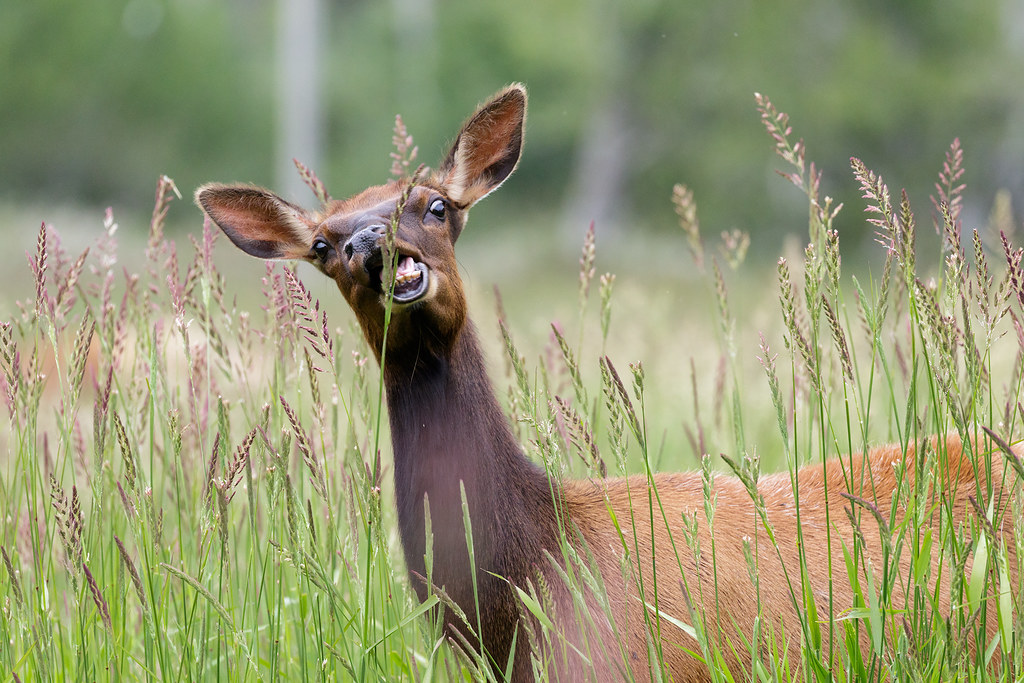
An elk cow seems to be enjoying her grass dinner in the appropriately-named Elk Meadow in Prairie Creek Redwoods State Park.
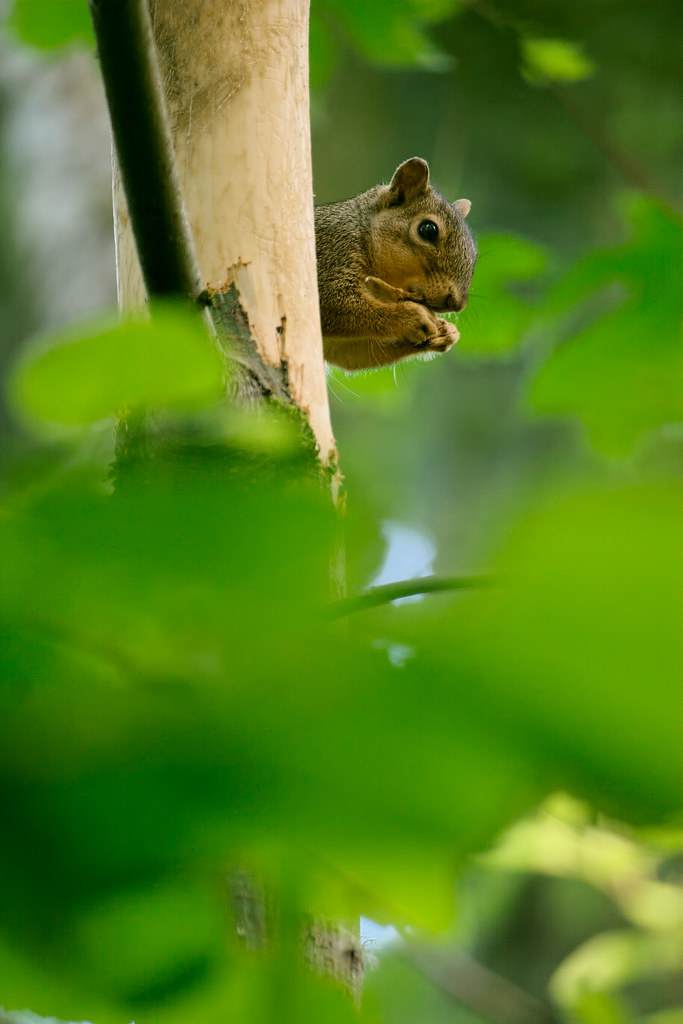
An eastern fox squirrel strips eats bark that it has stripped from a tree. It had already pulled off quite a bit of the bark near its perch. The eastern fox squirrel is not native to this area but is commonly seen in the Portland metro area.
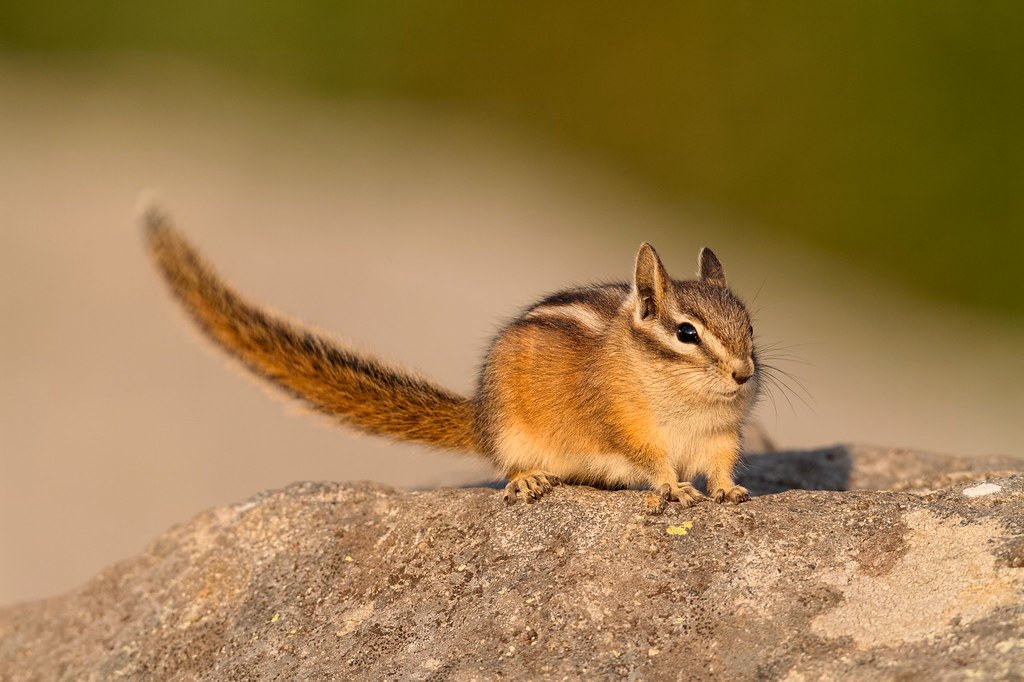
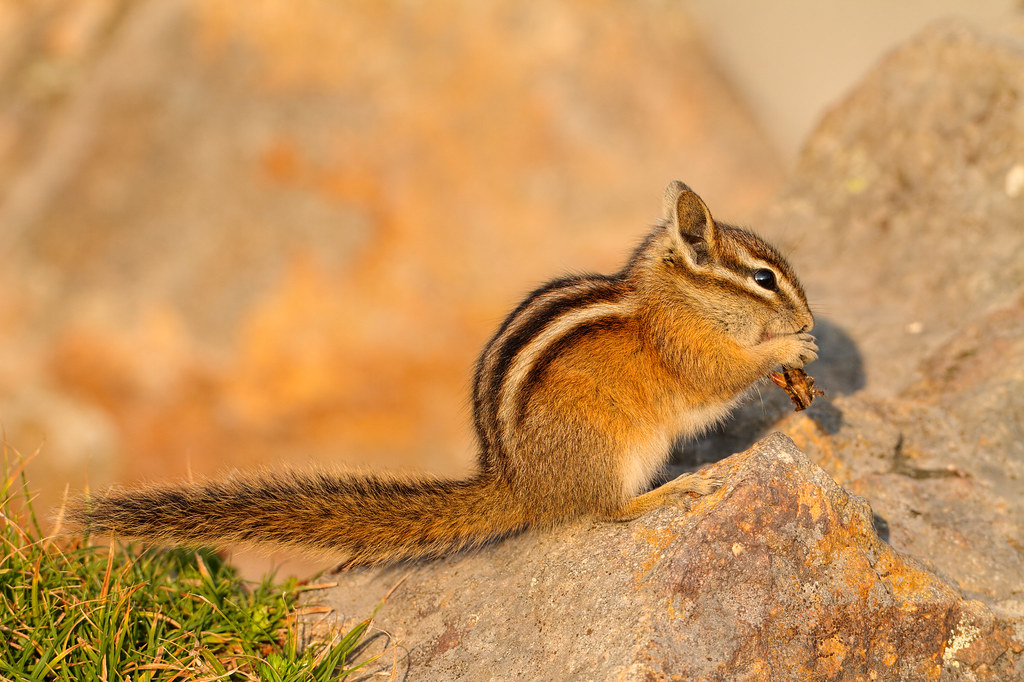
I had been watching this chipmunk feeding near the trail in Mount Rainier National Park for quite a while when it straightened out its tail and began whipping it back and forth. I looked behind me, then checked the skies, but couldn’t see what had raised the alarm. There were some grouse feeding nearby that were partially obstructed but they had been there even longer than I had.
I soon got my answer when it ran over right in front of me and picked up a grasshopper that had been smashed underfoot by a hiker, then ran back to the big rocks to eat it. Even though I had been watching it for a while, I’m guessing the tail flashing was one last test to make sure I meant it no harm. When it was done eating, it actually ran between my legs and on down the trail.
I guess I passed the test.
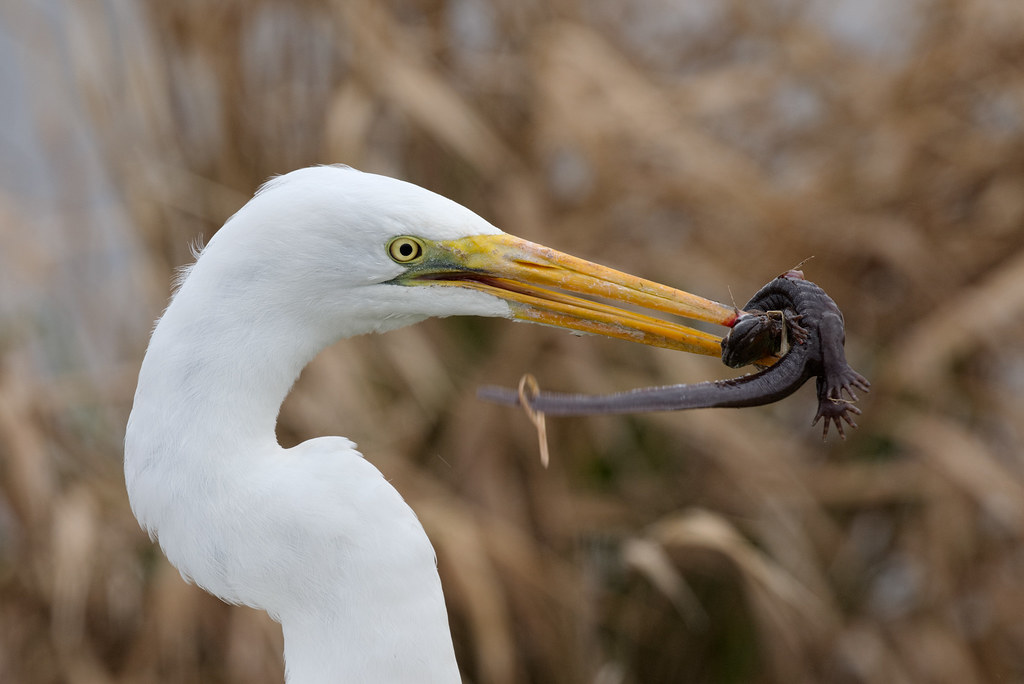
While I normally like to arrive before sunrise, I got a late start to my visit to the refuge in late February, as I was tired and decided to sleep in, arriving after noon. There was a great egret at the edge of Horse Lake, right at the start of the auto tour, so I pulled over and set up to take portraits since it wasn’t on the hunt.
Or so I thought.
Unfortunately my camera wasn’t set up for action as the egret suddenly struck into the water and brought up this northwestern salamander. I’ve rarely seen these lovely salamanders, and only when they’re being eaten, as the terrestrial form (adults can be aquatic or terrestrial) is usually below ground. During breeding season they move to the water to breed, and I believe late February is prime mating season for these salamanders at sea level, so hopefully it had a chance to pass on its genes before the egret caught it. I’ve never seen one this large, I was rather taken aback when I saw what it was.
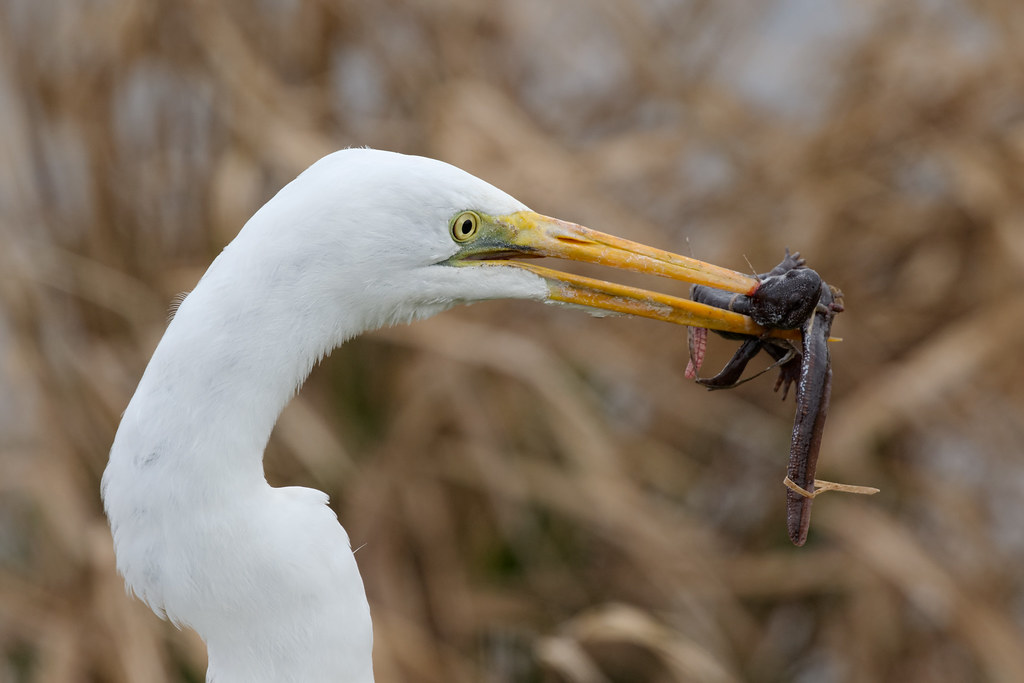
When i first saw the white spots running from the head of the salamander down to its tail, I assumed it was part of its coloration and was confused when I later read that this is not the case. I couldn’t see that it could be any other species, but then I read that the white spots are poison that the salamander releases as a defense mechanism.
I don’t know if it explains something I found a little odd, as when the egret first caught the salamander it brought it out of the water and tossed it several yards away into the grass. It seemed rather upset and agitated with the salamander, perhaps I thought because the salamander’s long tail kept thrashing back towards the egret’s eyes, and I thought to myself, “Well, you are trying to eat it!”, but perhaps it was upset because it got a taste of the poison.
The egret grabbed and tossed the salamander multiple times, I was surprised at how long the little thing put up a fight. The egret’s first strike had opened a hole in the salamander’s side and some of its internal organs had come out, so it was going to die even if it managed to get away, so I wished I could tell it to just give up and its agony would end. Eventually it did stop fighting as much and the egret gave it a good dunking in the water, after which the salamander’s body went limp and its legs hung to its sides. The egret swallowed it in one fell swoop. I wonder now, although probably much too large to be killed by the poison, if it made the egret sick, and perhaps it might give the next salamander a pass.
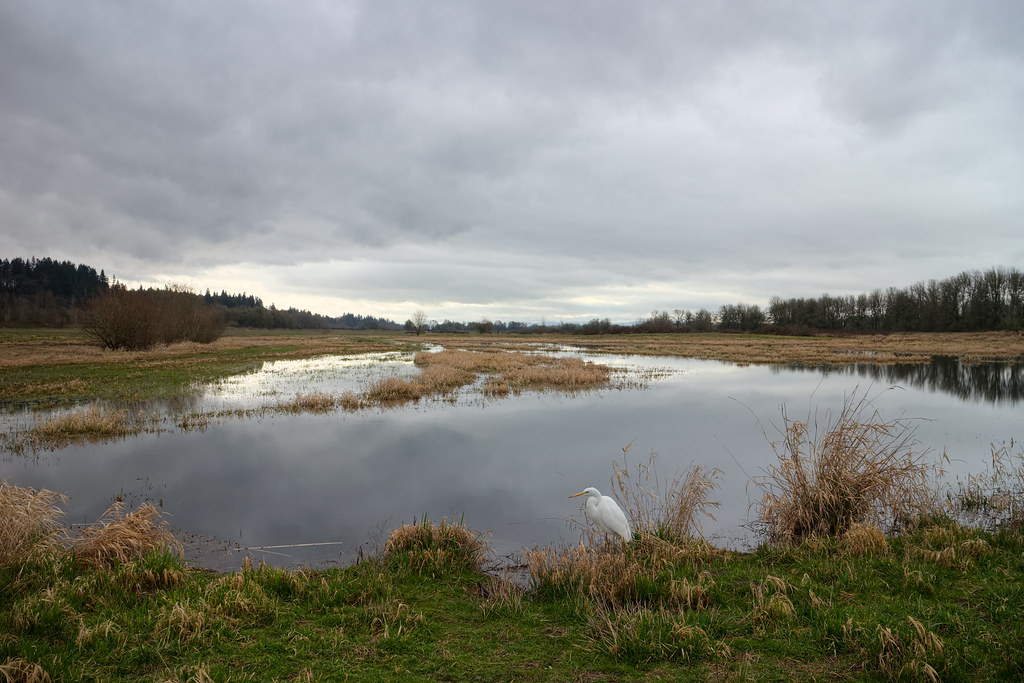
After I got over the thrill of seeing this magnificent little creature and the shock of watching it die, I reflected on how amazing it is that, just feet from where I have spent many, many hours sitting and watching and listening at this pond, an entire world exists under the water that I have little knowledge of and no way to observe. I would have never known this magnificent salamander was there if not for the egret (this wider view of Horse Lake shows the egret not long before it caught the salamander, just over to its left).
Above the water I can watch and learn, but the things below I see only when they are brought out from the water and into the air, usually as they die. That makes me a little sad, but this encounter did encourage me to learn about the salamanders as I knew nothing about them before, apart from the name. Their numbers declined by one that day, but the northwestern salamander population in general is doing well in its range on the western edge of North America, from northern California up through British Columbia.
Maybe one day we’ll meet on friendlier terms. In the meantime it makes me happy knowing they are there, even if I can’t see them.
It also made me happy to see that, a while back, one of my pictures was used for the good of salamanders, as the U.S. Fish & Wildlife Service used my favorite rough-skinned newt picture on their Facebook page to announce some steps they are taking to protect our salamanders from a fungus that is killing them elsewhere. I like how Flickr displays the usage rights I set for my pictures, as I set most of them so they can be used for non-commercial purposes, a long-standing tradition dating back to when I first started putting my pictures online back in the mid-90’s.

The rain here in the Northwest is frequent during the cooler months but it’s usually more drizzle than downpour, yet it has absolutely poured at times this month. I love photographing in the rain and am always a little disappointed when there’s a good strong shower but nothing to shoot. Fortunately I was already watching a group of shovelers feeding in Long Lake when a sudden deluge of large raindrops pounded the surface of the water. The ducks of course are built for wet weather and fed unabated, and soon enough the rain softened in intensity.
📷: Canon 7D II | Canon 500mm f/4L IS USM + 1.4x III
🗓️: December 23, 2015

We set a record for the wettest December ever when we were only three weeks into the month, and it has often rained since then, so it is no surprise that the water levels at Ridgefield are a little high. But not nearly so much as this picture would suggest, that sign is back near a hunter’s blind near the shore of Bull Lake, which itself is managed to mimic the flood plains of the Columbia before the dams went in. An unusually hot and dry summer left us with little snowpack in the mountains and we haven’t seen the widespread flooding we got when I moved here almost twenty years ago.
I took advantage of a two week vacation from work to return to Ridgefield (and going out to do photography in general) after a year’s absence. I’ve been up there six times so far and will probably go a few more times before it is time to head back to work. I’ve had a lot of fun and mostly photographed animals I’ve photographed many times before, biggest surprise was finding a short-eared owl up close, but I’ve been more surprised by what I haven’t seen: mammals apart from the ever-present nutria, and more importantly, my beloved bitterns.
I knew I was going to be hard-pressed to find bitterns when I drove by Rest Lake, which has by far been my best spot to find them the past few years, and saw that the way the water and the plants are in that area, the bitterns would be a lot more exposed than they like to be. I looked for them on every visit but didn’t see a single one. I still have a lot of old pictures to edit and get back online so regardless bittern pictures will be coming.
It was good to be back, the key will be to keep the momentum going and keep heading out once I’m back at work, as it is going to be a hectic month or two.

A hoary marmot collects grasses and flowers late on a fall day in Mount Rainier National Park. I didn’t think it could add more without dropping what it already had, but I was wrong. After adding that last bit it was either satisfied with its collection, or felt unable to collect any more, and trundled off towards its den.

 Boolie