
A red-tailed hawk flies above Ridgefield National Wildlife Refuge as the sun is about the clear the trees atop the hill that overlooks the refuge, while fog hangs above the river and lakes.

Scratcher of heads, rubber of bellies
A red-tailed hawk flies above Ridgefield National Wildlife Refuge as the sun is about the clear the trees atop the hill that overlooks the refuge, while fog hangs above the river and lakes.

A flock of cackling geese flies in the familiar V formation as the sun is about to rise above the hill that overlooks the refuge, while fog settles in down near the river.

Sunrise at Horse Lake, frozen solid on a cold January morning.
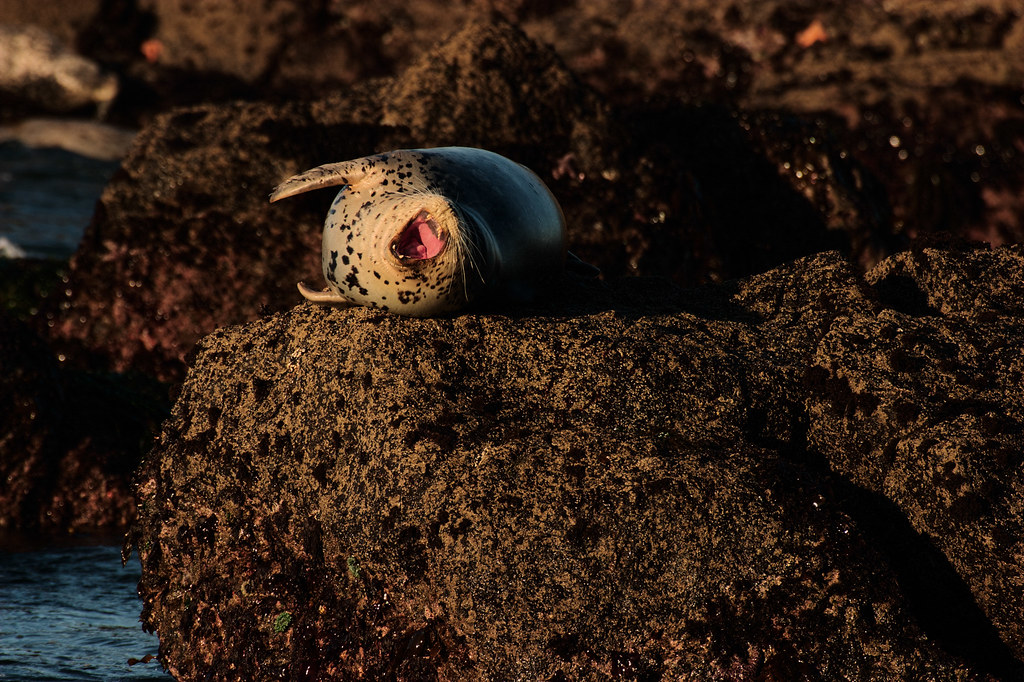
An adult harbor seal lets out a big yawn on an early spring morning. It had a much higher perch than the younger seals and was able to enjoy the sun while they had to yield to the incoming tide.

The higher elevations in the Sunrise area of Mount Rainier got a light dusting of snow on the morning of my last day there but it melted when the sun rose. After hiking a bit on the Sourdough Ridge Trail early in the day hoping to see marmots, pikas, or grouse (and not seeing any), I went a little lower in elevation to the trailhead of the Summerland Trail. The trail is an uphill march mostly through a forest before you pop out into a mountain meadow at the very end of the trail, I chose it since there was a chance of seeing hoary marmots and elk in the meadow (the mountain views from the meadow are also spectacular and make up for the lack of views in the forest).
I didn’t see any elk but I did see a few marmots when I first entered the talus field. The afternoon sun didn’t make for good light for pictures but this marmot was shadowed by rocks where the snow hadn’t melted. I followed the trail through the rocks and saw more and more marmots until I realized just how large the colony is at the end of the trail, this was by far the largest marmot colony of any species I’ve come across.
I spent the rest of the afternoon watching the marmots as at least one was usually close to the trail, taking advantage of every passing cloud to improve the light. I had thoughts about staying until sunset but I still had a long hike back down and while I had my headlamp, I was hiking alone and didn’t want to risk it. When the marmots that had been near the trail were no longer around, I took that as my cue and headed back down the trail.

This is the same pika that I denied a taste of my mango, as you can see it was quite adept at finding food on its own. It had just sprinted across the talus field with these twigs in its mouth, it paused for a moment and straddled these rocks before disappearing below to add to its winter store.

Ever since first seeing pikas in the Tetons, I always choose some of my hikes on my Wyoming trips to go into terrain where I might glimpse these little mammals. So it should be no surprise that I chose many of my hikes on my trip to Mount Rainier to put me into the land of marmots and pikas. At first I had only near misses at pictures as pikas scampered along the Sourdough Ridge Trail, dragging plants down into their homes under the rocks. But at the end of my first full day of hiking, the Palisades Lakes Trail blessed me in abundance.
I stopped at a talus field near the end of the trail for some water and snacks, hoping that a pika might poke its head out from the rocks while I rested. I had heard but not seen them in the area as I passed by at the start of the hike, but it wasn’t long after I opened my water bottle that this pika first appeared. It was busy adding plants to its cache under the rocks, occasionally stopping to eat a little. I took a number of pictures while it was active, spending almost half an hour watching it as it gathered food. During the stretches where it was out of sight, I swapped the camera for my water bottles.
I took me a while to quench my thirst as I picked up the camera any time the pika popped up, but eventually during a quiet stretch I turned my attention to my hunger and brought out my bag of snacks. We had picked up some dried mango slices shortly before I left, I had never tried them before but they immediately became my favorite treat of the trip. As I started into the mango the pika suddenly reappeared, so I closed up the bag and set it a nearby rock before picking up the camera for more pictures.
The pika kept ducking in and out of the rocks, classic pika behavior, but I could hardly believe my eyes when I realized that the pika was actually working its way in my direction. The little thing was soon too close for pictures so I just stood baffled by such a close encounter. I soon realized its intention as it shuffled over towards my snack bag and sniffed around. I eased over and took the bag away, having just watched it store away a variety of plant life I feared my dried fruit was about to be added to the cache and enjoyed all winter long by my furry friend.
It hung around for a little while, almost at arm’s reach but always with an escape route into the rocks. The timing was probably coincidence, but when I finished the mango it either lost interest in the remaining fruit or realized I wasn’t going to share and headed back up the slope. I finished my snack and hoped for more pictures, but it wasn’t long before the pika went under for good and I continued up the trail.
I couldn’t help but feel guilty about not sharing my bounty, given that it posed for so many pictures, but better to keep them wild. Besides I knew from our time together that it wasn’t going to go hungry this winter, even if it was going to have to miss out on the mango.

A hoary marmot at the end of Mount Rainier’s Summerland Trail eeks out the last bit of warmth from this sunlit rock before the mountains blocked the sun and threw its perch into shadow.

When I think of bird feathers, I usually think of the large wing feathers. But birds have feathers of all sizes, and one of the fun things about close-up pictures like this is getting to see the individual feathers of all sizes. For example, although the eye ring of this sooty grouse looks like a solid band from a distance, up close you can see that it is actually a ring of tiny little feathers.
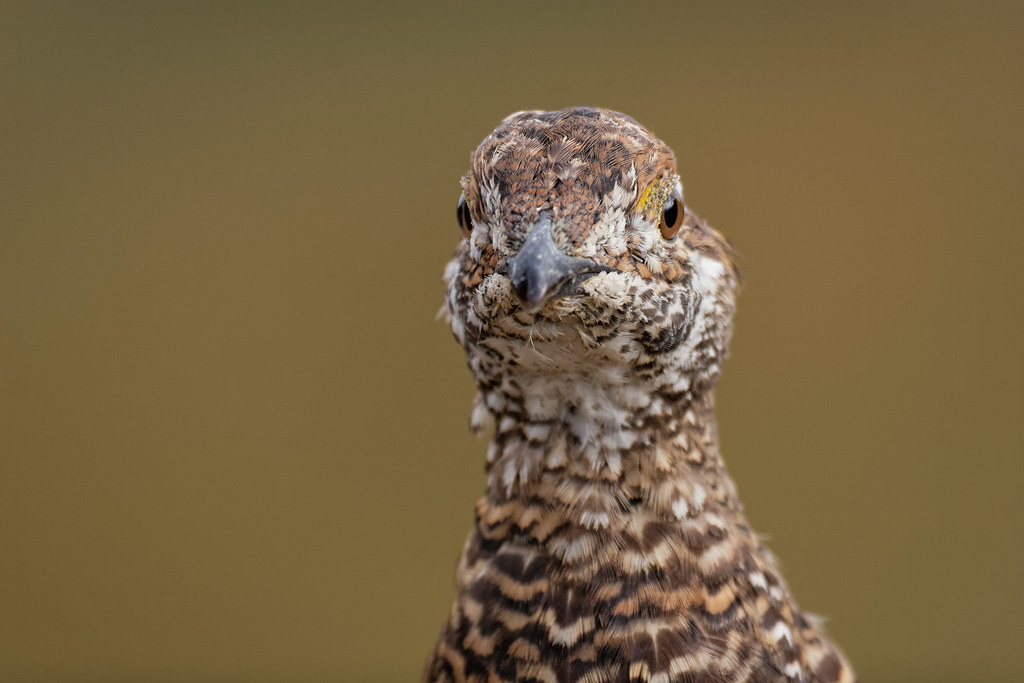
If you’ve followed my blog for a while and have a photographic memory, this picture will seem a little familiar. It certainly seemed familiar to me when I took it. This view of a sooty grouse is very similar to a picture I took last year of a dusky grouse while in the Tetons. Not exactly the same of course, the head is turned at a different angle and the light and colors are different, but I certainly had the older picture in mind when I took this one.
Sooty and dusky grouse used to be considered two races of one species, blue grouse, but were recently split into separate species. Here in the Northwest, the sooty grouse tend to be in the areas from the Cascades and west to the coast, while duskies tend to be in the eastern interior.
This picture is from the Sourdough Ridge Trail in the Sunrise area of Mount Rainier National Park, the trail where I saw grouse the most often. I also saw them down by the Paradise Inn, and saw one in Olympic National Park at the end of my trip.
That last encounter in the Olympics was the most like my experience with the grouse I photographed in the Tetons, I was driving out of the park when I saw one in the road in front of me. I stopped the car and turned on my hazard lights, as the bird was moving slowly and in no hurry to get out of the way. I got out of my car and encouraged it to hurry across the road, which is fortunate as a pickup came driving past right afterwards.
That’s twice now I’ve played crossing guard for grouse.
 Boolie