Lunch for One

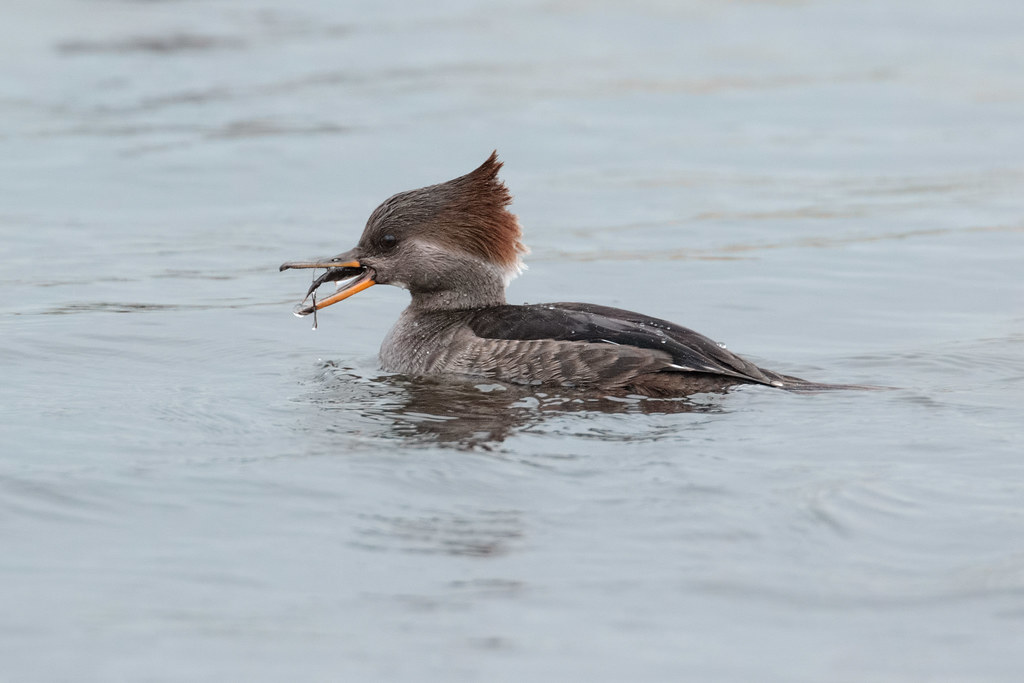
A female hooded merganser swallows a fish

A hooded merganser swallows a fish she just caught in the shallows of Long Lake. She’s swimming away not from me but rather the other mergansers in her group who would be more than happy at the chance for a free meal. Once she surfaces with the fish she’s got to get it oriented head-first, lengthwise down her long thin bill, and toss it back and swallow it. The still squirming fish sometimes gets dropped even when alone, much less in a crowd, so a little private space is always welcome.

A Closer Look

A close-up view of a great egret

Not only was I fortunate to be able to photograph great egrets numerous times in December, but even on this day I had several opportunities, including full-body portraits as one caught numerous bullfrogs. There were times I saw egrets very close to the road but in each case someone else had stopped and, rather than risk spooking the bird, I continued past.

Late in the day I got my chance at a close look when I came across this egret at Rest Lake. It was mostly watching the water for frogs but occasionally if another car came past it would gently turn its head in my direction. That rarely happened as there was a sudden lull in traffic, but I spent a lovely twenty minutes watching it at close range before it finally took flight to chase off another egret that had flown in a ways down the shore.

An End to Hibernation

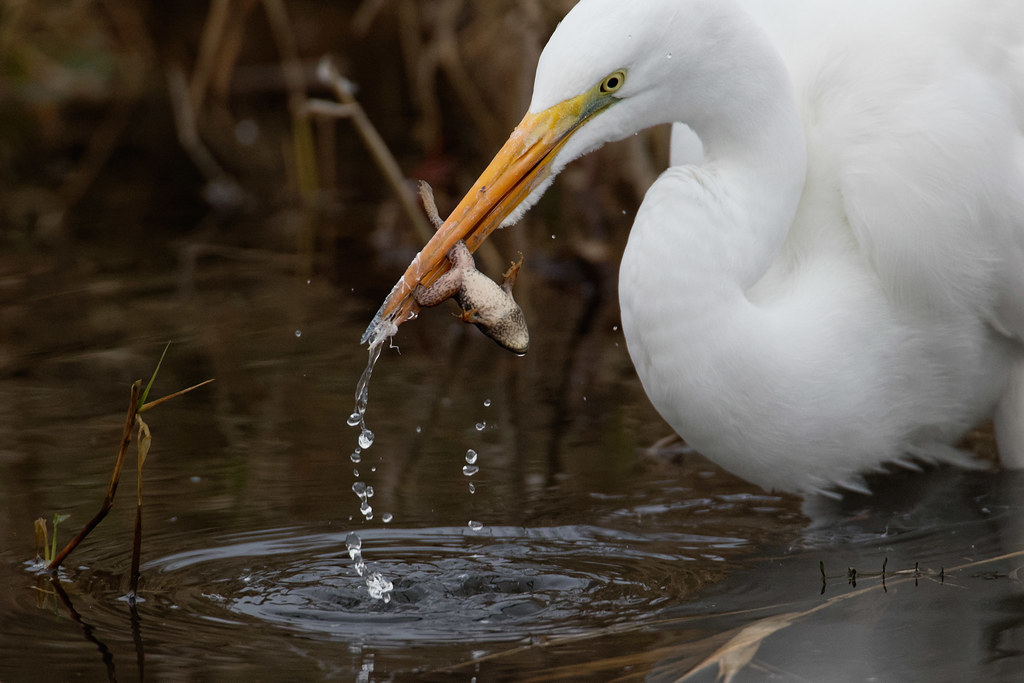
End of Hibernation: The Dunk

Bullfrogs hibernate during the winter so their metabolism slows significantly and they aren’t very active but they don’t bury themselves in the mud the way a turtle might. Many bullfrogs at Ridgefield found their hibernation cut short this winter by the herons and egrets and bitterns that worked the shallow channels and ponds of the refuge.

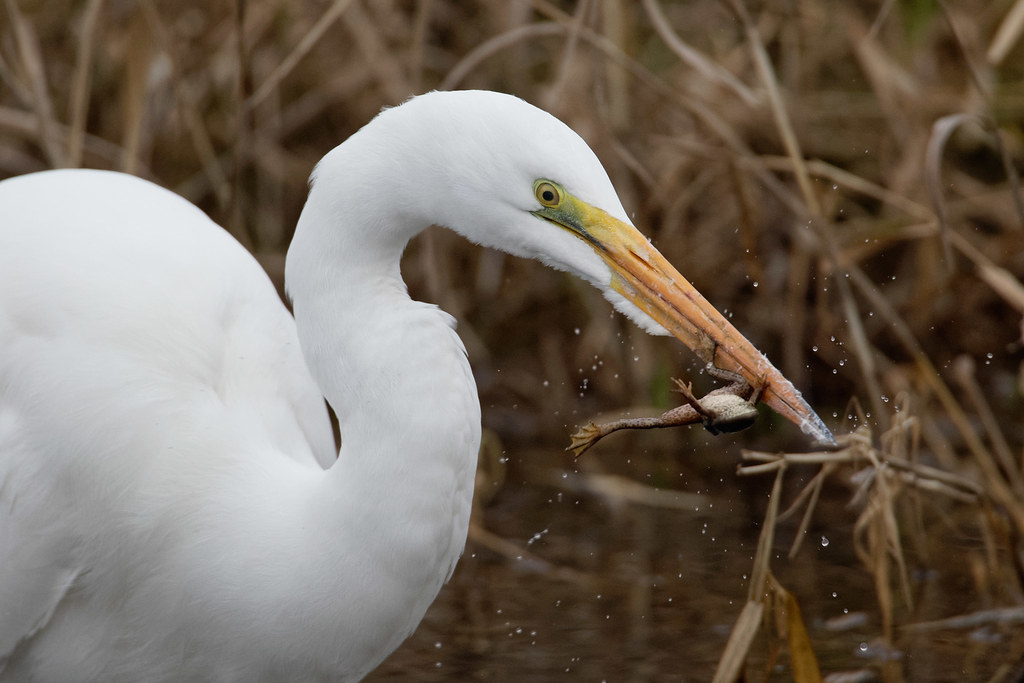
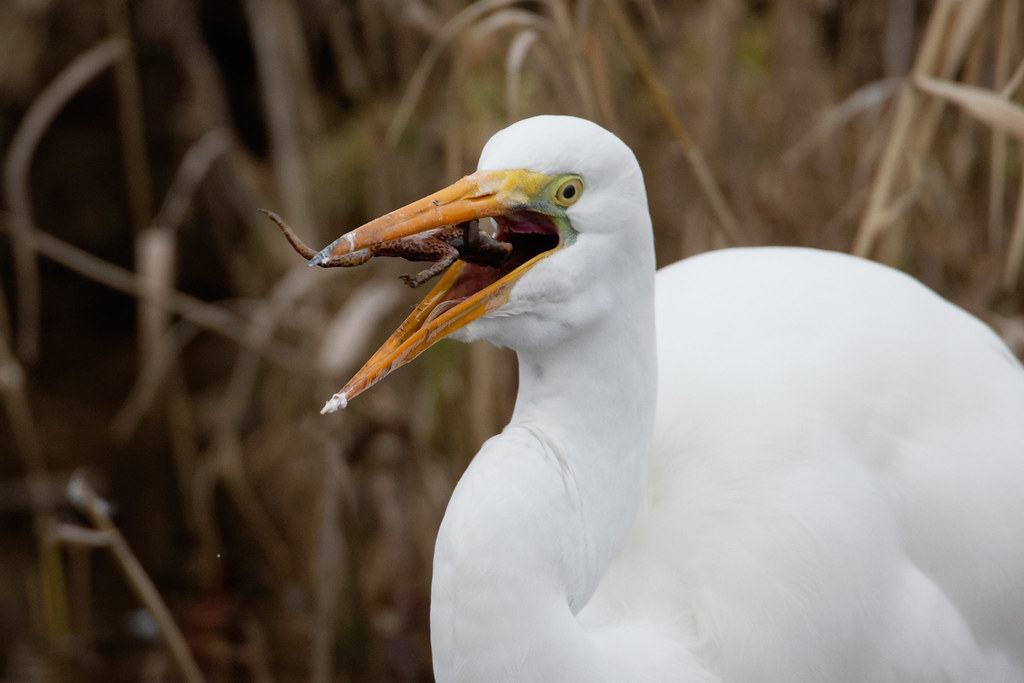
This egret in particular was just walking up and down one such channel, avoiding a great blue heron doing the same, striking at bullfrog after bullfrog, following a familiar process between catching the frog and eating it. First, the frog would be dunked quickly into the water, as shown above. Next, the egret would spin the frog rapidly, presumably causing massive internal injuries to the frog, as shown in the following two pictures. In the first picture, the egret has closed the nictitating membrane in its eyes, a transparent third eyelid that protects the eye from damage while still allowing the egret to see, as water spins off the frog and its clawed feet flail about, while in the second picture the membrane has been retracted.

End of Hibernation: Spin Cycle No. 1

End of Hibernation: Spin Cycle No. 2

Then the egret would toss the frog into the air, catching it in a different place on its body, and either repeat the process again if it caught it by a leg, or perhaps crush it in its beak if it caught it by the body. This would happen multiple times until I gather the frog had died or given up fighting, although with the egret constantly keeping the frog moving it was hard to tell exactly when or if the frog itself stopped moving.

End of Hibernation: Throw & Catch

The final step was to position the frog head first in its beak and swallow it whole. Bullfrogs are voracious predators and, as they aren’t native to the area, have had a big impact on some of the other small creatures in the ponds and sloughs. However I’ve seen the bullfrogs themselves become prey for the larger predators of the refuge, including not just egrets and herons and bitterns but otters, raccoons, and grebes.

End of Hibernation: The End

Four Hours

A close-up view of the head of an American bittern

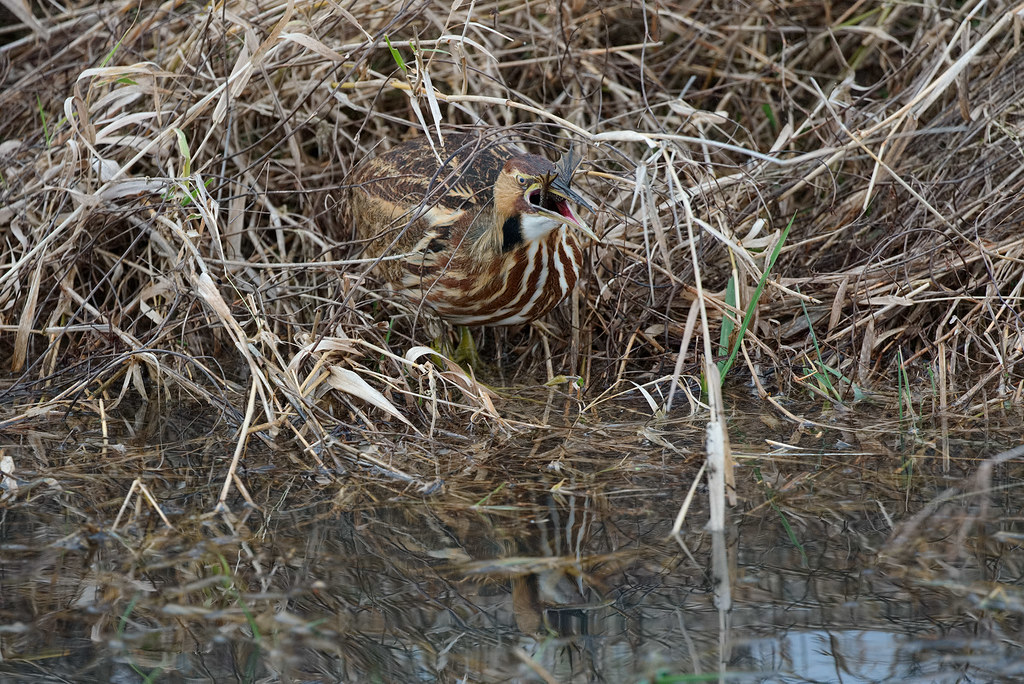
In December 2013 I visited Ridgefield after a long absence and came across this bittern late in the day as the sun momentarily peaked through the clouds, giving me some beautifully soft light. It lasted but a moment and the bittern was moving as it hunted along the shoreline, so I was thankful I got a nice picture when it paused for a moment in the open in front of water that was reflecting a patch of blue sky.

The funny thing is, I came across this same bittern four hours earlier in a very similar spot and a very similar pose, but then it was completely overcast and raining, leaving some small drops on the bittern’s head. I like each picture for different reasons, but it clearly shows the impact of not just the different light but also the different reflections in the water, as in this picture all of the sky was gray.

A close-up view of the head of an American bittern

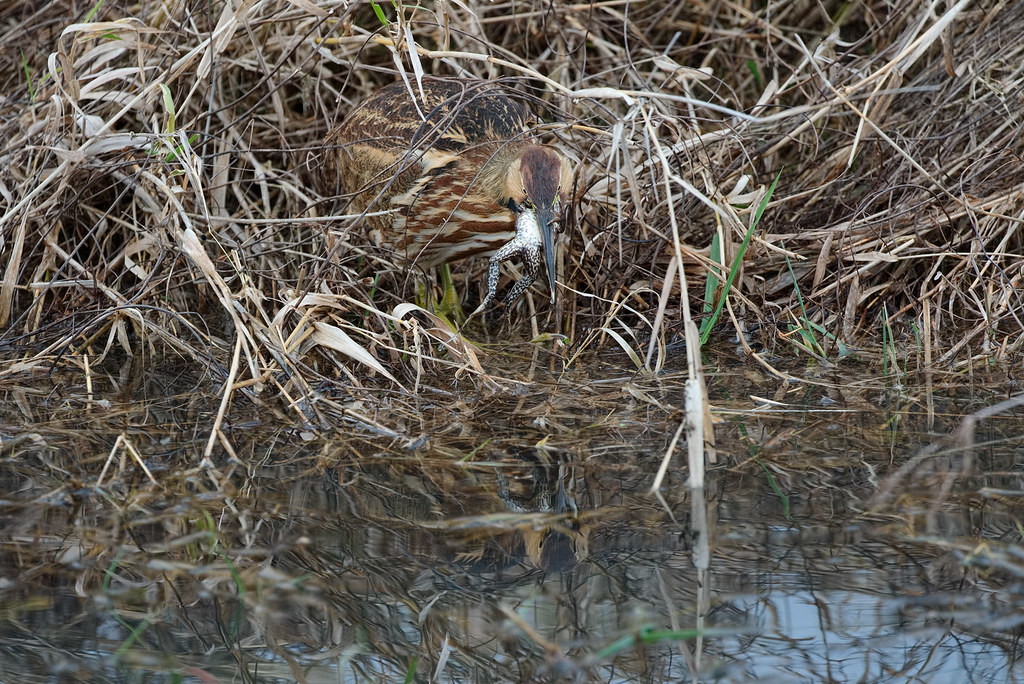
A Mouthful of Bullfrog

An American bittern prepares holds a large bullfrog in its mouth

Normally I’m pretty good at spotting bitterns at Ridgefield but I saw them on only three out of ten visits to the refuge over the Christmas break. I worried I was losing my touch until I found this bittern on Christmas Eve slowly working the channel beside Rest Lake. I suspect the real reason I haven’t seen as many this year is that the grasses in this area, normally my best spot for seeing them, have been cut lower in places, eliminating cover for both the bitterns and the animals they are hoping to catch.

The bittern snagged a large bullfrog from the water as you can see in the top picture. In the picture below the bittern has swallowed most of the frog with only the rear feet sticking out of its mouth. The bittern has protected its eyes from the frog’s claws with a nictitating membrane, a common tactic in the chaos of swallowing something that doesn’t want to be swallowed.

An American bittern swallows a large bullfrog

New Year’s Day

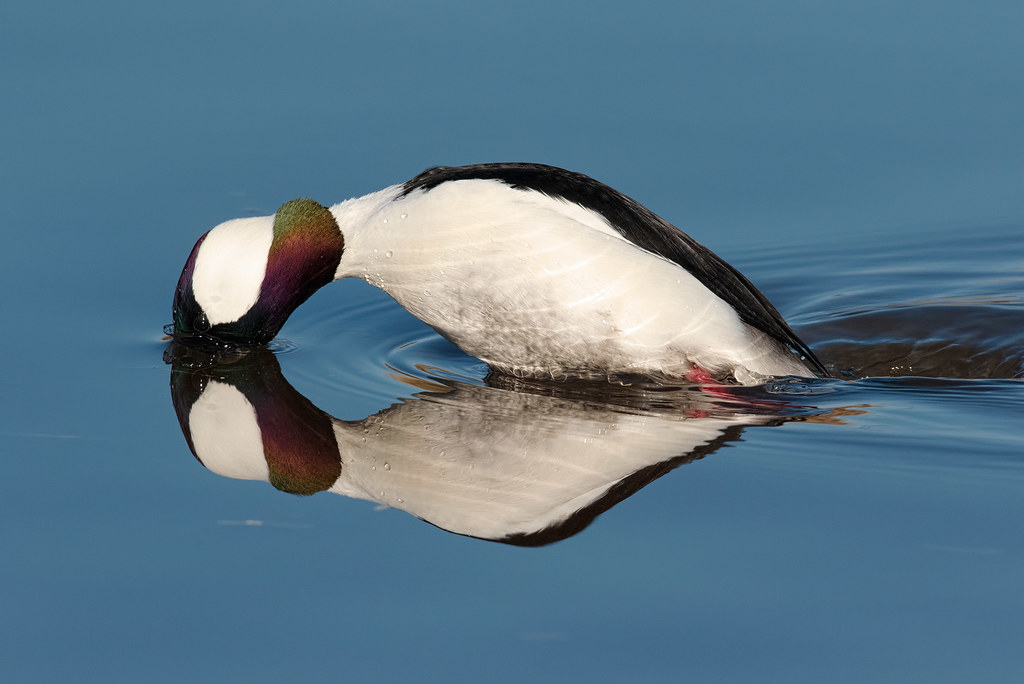
A male bufflehead dives under the water to feed

I started 2015 the way I ended 2014, visiting my favorite little wildlife refuge. We had a cold snap that froze some of the smaller ponds and this male bufflehead was one of two that were hanging out with a flock of American coots working a small section of open water near the road. Like other diving ducks, bufflehead flatten out their tails on the surface of the water and push themselves forward into the dive, using their beaks to break the surface tension of the water.

Lovely way to start the year.

Water

A great egret eats an American bullfrog in the rain at Ridgefield National Wildlife Refuge

In 2001 I bought what at the time was my most expensive lens, Canon’s 100-400mm lens. Since then it’s gone with me on every hike and nearly every trip and been one of my most treasured lenses. However the image stabilization system needs repair but I haven’t sent it in as I was hesitant to spend much money on a lens that could benefit from a modern re-design.

To my great delight, Canon finally brought out a new 100-400 lens and I pre-ordered the day of the announcement. It arrived on Friday so Saturday morning I opened it up and took it to my favorite refuge to try it out. One of the nice new features is that the lens has some weatherproofing, which I got to test with my very first pictures when I encountered this egret in the pouring rain. The egret was on the passenger’s side of the car so I slid over, stuck the lens out the window into the rain, and had just got the exposure and focus set when the egret struck into the water, pulling out this small bullfrog.

I meant to frame a little looser but in my haste to even get the shot I didn’t keep the camera quite level, so I rotated and cropped in post. Still I was pleased that with the zoom I was able to pull back and show a bit of the world these animals live in. The egret with its long featherless legs is built to wade in shallow water like this, able to hunt along the water’s edge, looking for frogs and fish in the water and frogs and voles on the land.

I’ve always loved photographing in the rain, especially to show how animals still have to go out into the rain to live their lives, and I’m thankful my favorite hiking lens now can as well.

Mr. Boolie Goes to Washington

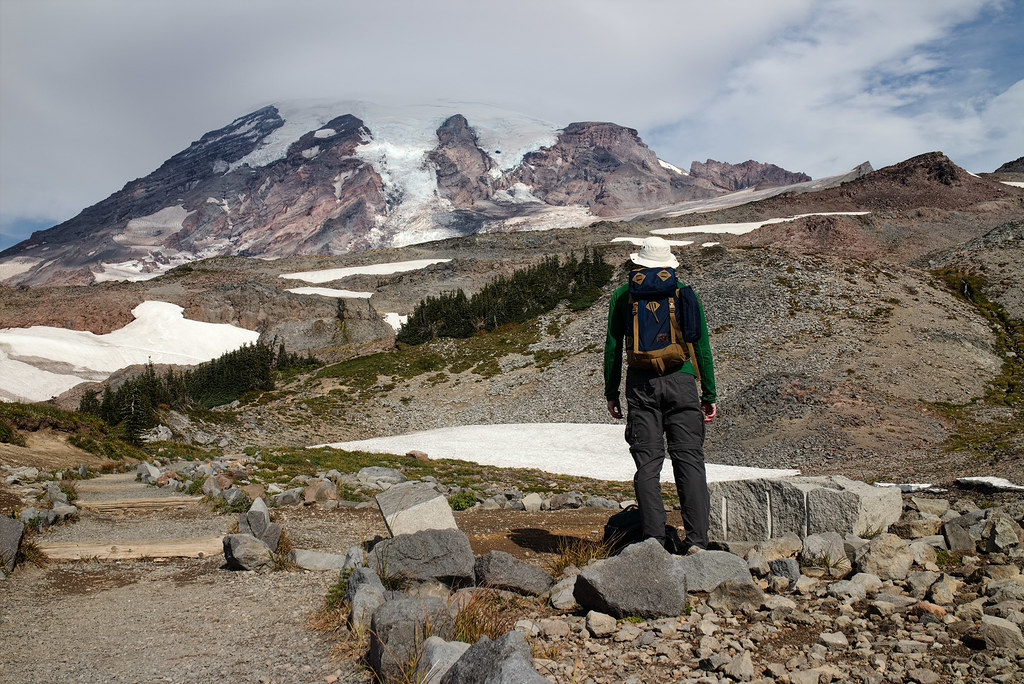
Rick Cameron stands in front of Mount Rainier

I was trying out a lot of new hiking gear on my weeklong hiking trip in September to Mount Rainier National Park and Olympic National Park. In the picture above, the hiking pants and hat are old, but everything else I’m wearing is new right down to my socks and shoes and undies, and it all worked out rather well. The green wool hoody I’m wearing, an Ibex Hooded Indie, I loved so much when I got home I ordered two more for myself and another for my wife.

The backpack is The Guide’s Pack from Tom Bihn, this was my first time hiking with it and it did great. In the pack were more new items, including an Ibex wool coat (the Shak Lite) and an Outdoor Research rain shell (the Foray), both of which I was wearing earlier in the morning but took off as the sun came out, and both of which got tested over the next few days as the rain and cooler weather rolled in. I can’t speak yet to how they will wear with time, but so far I’m sold on the Ibex wool layers, they’re thin and easy to pack but dried quickly and kept me warm when it was cool but I didn’t overheat in warmer weather. This was my first time not wearing cotton layers and I was surprised at how much more comfortable I was, to the point that I began to feel rather foolish for not having moved away from cotton years ago. The Foray rain shell also did well, not a drop of rain got through and it seemed to breathe better than my previous coat.

My shirts were some new synthetic shirts from a variety of outdoor companies as well as one wool shirt from Ibex, and those too I was pretty happy with. Cotton is still the softest but these performed much better on the trail when I started to sweat and were still plenty comfortable.

Funnily enough it wasn’t my new gear that failed me, but rather my trusted old hiking shoes, I learned the hard way that they aren’t as waterproof as they once were. Fortunately I had brought some other new shoes that I pressed into service, even though I had planned for them to be more general purpose shoes. I’ll pick up some new waterproof hiking shoes this fall.

The Tom Bihn Guide's Pack holding a Canon 500mm lens

The rucksack design of the Guide’s Pack allows it to swallow a variety of loads. I ordered it thinking I’d pack it with my normal hiking gear, but when it arrived I realized it could hold my Canon 500mm telephoto lens. I hiked with the big lens quite a bit on this trip, too much to be honest, as it weighs 8.5 pounds and I wasn’t in good enough hiking shape for that much weight. The backpack has a frame which helped with the weight, but with all the elevation changes I ended up a bit too tired on some days. Normally I’ll carry a more moderate load as I realize this heavy of a load could shorten the life of both the bag and its wearer, but it’s nice to know I can take it on trails where I expect to see a lot of wildlife. Which on this trip meant trails where from past experience I expected to see pikas and marmots and I came away with some pretty nice pictures thanks to the new bag.

Still, I’d like to limit how often I carry that heavy of a lens and will look for something a little more portable than the 500mm lens but that can replace my aging 100-400mm lens, as it is in need of repairs but I’m hesitant to spend much money on it as it lacks some features of more modern lenses (including weather proofing).
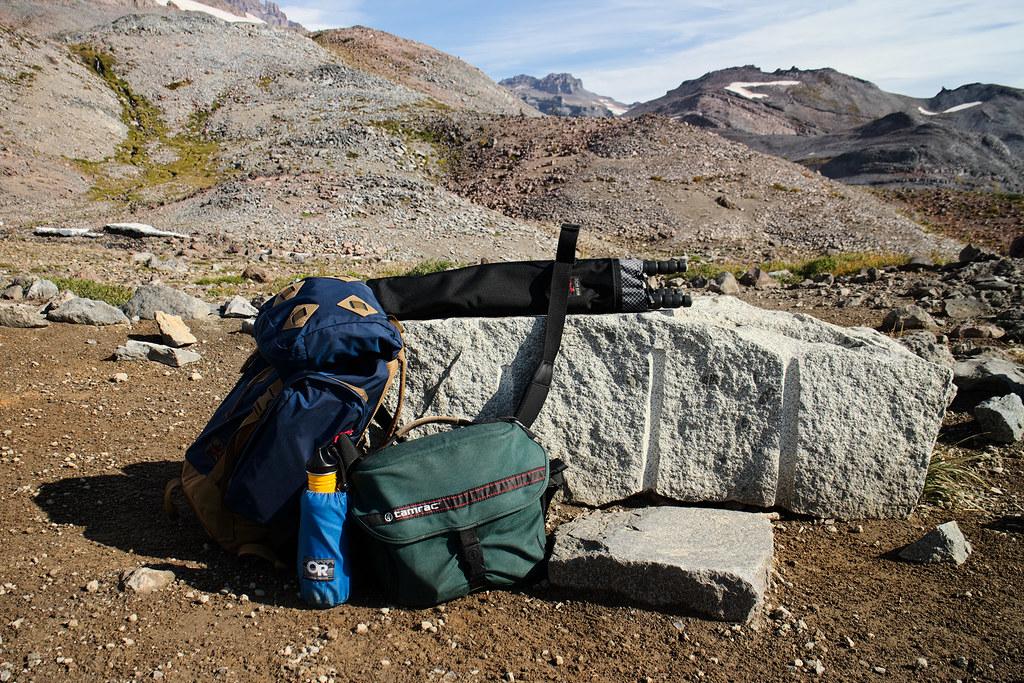
Bags for carrying camera gear on a hike

This was my normal hiking setup in terms of the bags I carried, what varied was how much camera gear I carried on any particular hike. The Tripod Quiver (also from Tom Bihn, and also new for this trip) held my Gitzo carbon fiber tripod, while the backpack held either my Canon 500mm lens or the 100-400mm lens, plus extra coats and clothes and food. The Tamrac camera bag held my 100-400mm lens when it wasn’t in the backpack, my Canon 7D SLR, and my Canon M mirrorless camera, plus a water bottle for easy access (new water bottles for the trip too).

I had intended to take the new bags on short hikes closer to home before the trip but ran out of time, so they got pressed into heavy duty service immediately. Not to worry, they both worked out great. I got constantly drenched on multiple days and while the dampness did eventually penetrate the bag, I had everything inside in smaller bags so everything stayed dry. I will probably look into a rain cover for future use, even though I typically don’t have to hike in such a steady rain, but it would be nice to have for emergencies.

One thing I wish I had more of was stuff sacks for the extra coats and clothing I kept in the bag. I had one for one of my layers and attached the bag with key straps to the o-rings in the bag, which made it easy to find and access when I wanted to put on the jacket. But I didn’t have stuff sacks for the other layers and their zippers scratched the paint on the big white lens. Easy enough to rectify on my next Tom Bihn order.

The Tripod Quiver I originally intended to attach to the backpack but found that carrying it on its own with the Absolute Strap was both comfortable and convenient. I took the tripod on every hike, something I’ve been loathe to do in the past, so that worked out nicely.

All in all the new gear worked out well and made for more enjoyable hiking.

The Tamrac camera bag certainly wasn’t new, I bought it the mid-1990’s and it has been with me on every hike since. Like the Tom Bihn bags, it was made here in the United States, and even outlived the company that made it. I was in graduate school when I bought it based on some research, as even though it wasn’t very expensive, every dollar was precious back then. Even so I never would have believed it would be my hiking partner two decades later, but here we are. It fits nicely in overhead bins of even puddle jumpers, so it’s easy to take on trips.

The Tom Bihn Guide's Pack in front of Mount Rainier

Since it can sometimes be hard to judge the size of things when online shopping, I thought I’d provide this helpful size comparison of the Tom Bihn Guide’s Pack. Based on my preliminary observations, I’d say it’s somewhat larger than an iPhone and somewhat smaller than Mount Rainier.

The Tom Bihn Guide's Pack in my room at the Paradise Inn

Up above the tree line on Mount Rainier there’s a fine dirt everywhere so my beautiful new bag didn’t stay clean very long, as this shot from my room in the Paradise Inn shows. Which is good, because I haven’t been hiking enough the past couple of years and it’s a sign things are headed in the right direction. A dirty bag on the trails is better than a clean one in the closet.

The Tom Bihn Guide's Pack and Tripod Quiver on Rialto Beach

I was waiting for the sunset at Rialto Beach near the end of the trip and took a quick shot of the two new bags. The next morning I went to the Hoh Rain Forest and then drove back to my home in Portland. I’m not quite done getting bags, I’ve got my eye on an Aeronaut 45 for longer trips instead of my rolling suitcase, as at most of the places I stayed I had to carry the suitcase and the duffel/backpack style of the Aeronauts would have been much more convenient, and maybe an Aeronaut 30 and/or a Smart Alec for shorter trips.
Monumental

Rick Cameron poses in front of Mount Rainier

As I imagine future generations will want to erect a statue in my honor, I thoughtfully posed in advance to ease the design process. I was thinking it could be 200 feet tall and sit where the Willamette flows into the Columbia, turning so I’m always facing the sun. Statues of my pets could rise and fall in the river in the order we lived together, so that Templeton’s ears would break the surface of the water at sunrise, followed by Scout’s a while later. When Templeton descends back into the river, Emma and Sam would start to rise, and so on.

In this picture I’m in front of Mount Rainier, but don’t put the statue there, that would be a little ostentatious.