The Cactus Tree

A northern harrier sits on a stump in dense fog, early in the morning before the sun had broken through, taken on the auto tour at the River S Unit of Ridgefield National Wildlife Refuge in Ridgefield, Washington in December 2009

I’ve wanted to photograph the Cactus Tree since I first visited Ridgefield years ago, so I was particularly pleased to see this harrier perched on it in the heavy fog one winter’s morning (the picture from the previous post was taken later that morning when the sun first started to break through). It’s not a cactus of course, and these days not even a tree, just an old stump that reminds me of a cactus. It sits a ways off the road on the auto tour at Ridgefield, parts of the refuge are converted farmland so perhaps this stump is a remnant from when humans last lived here.

It’s a good thing I finally got a picture I liked, as on a visit not much later I noticed the stump was no longer standing, apparently having at long last fallen over into the marsh.

Turnabout is Fair Play

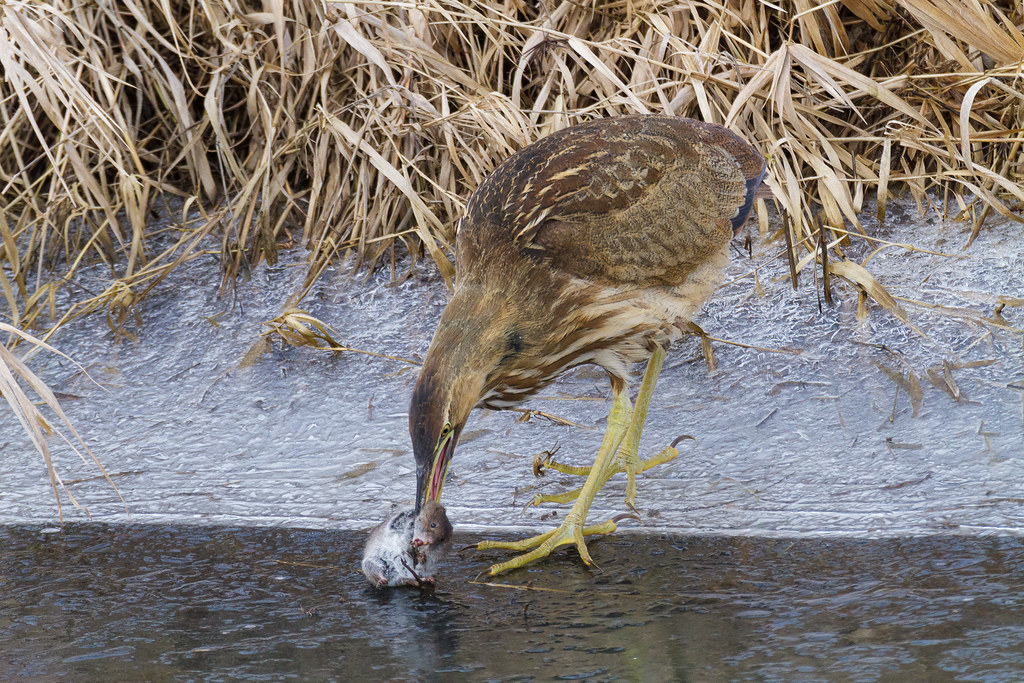
A close-up view of an American bittern catching a bullfrog at Ridgefield National Wildlife Refuge

One of the stories at Ridgefield this winter has been the American bitterns which have been putting on a show at several spots around the auto tour during many of my visits. I’ve always been on the lookout for bitterns so I’m not sure why I’ve had so much success watching them hunt lately, although it may have something to do with the fact that I spent far more time at the refuge over the Christmas break than I usually do. This bittern was mostly snagging small fish as it worked the channel beside Rest Lake, but at one point it stopped and started wiggling its neck side to side and then struck into the middle of the channel, bringing up this bullfrog. Bullfrogs themselves are voracious predators and, since they aren’t native to the Northwest, have combined with habitat loss to cause problems for some of our natives. This little bittern was doing its part to turn the tables and win one for the home team.

Falco

A female American kestrel perched on a plant at Ridgefield National Wildlife Refuge

There are a handful of true falcons that typically breed in North America, all belonging to the genus Falco, with the smallest being the American kestrel (falco sparverius). The kestrels at Ridgefield are pretty wary and often won’t stay perched if you pass on the auto tour, and probably for good reason, as there are a number of other birds of prey that share these hunting grounds that dwarf the little falcons in size.

This lovely female was a ways off the road and stayed still for a few pictures before she took to the skies again to resume the hunt.

Gang of Four

Four hoary marmots with an extensive amount of black fur sit on a large rock near the Skyline Trail in the Paradise area of Mount Rainier National Park in September 2009

All hoary marmots have dark fur in their face and feet, in some it extends into the shoulders and legs. But this gang of four, part of a colony near the Skyline Trail in Mount Rainier National Park, had the most dark fur I’ve yet seen, mixing in over much of their bodies. Some of the others in the colony had more typical coloring and they all intermingled between two large rocks, so I was pleased when these four finally got together to pose for their family portrait.

Waddling Clothes

Two young marmots play on a boulder in a mountain meadow as one of the adults looks on, taken on the Skyline Trail in Mount Rainier National Park in September 2009

Two young marmots play in a mountain meadow as one of the adults looks on. We came across this colony in the early fall beside the Skyline Trail in Mount Rainier. You can see how chubby even the youngsters are at this time of the year as they prepare to hibernate through the long winter on the mountain. Despite being wrapped in waddling clothes, the marmots move with surprising speed when they want to, bursting across the talus fields with a speed that belies their bellies.

Synchronized Preening

An adult American beaver preens and shows off its large flat tail in the early morning light at Ridgefield National Wildlife Refuge in May 2006

Early one morning on Mother’s Day, I stopped along the auto tour at Ridgefield to watch wood ducks in a quiet channel. A sudden dark form in the water caught my attention, I hoped for a beaver but knew it was more likely a nutria, the most commonly seen of the large rodents. Muskrat frequent the area as well but it was too large to be a muskrat.

My first impression from the size and shape of the head was that it probably was a beaver. There was little doubt left when its large, round form emerged onto the far bank, and no doubt remained when its broad flat tail finally came out of the water. I was feeling pretty blessed, watching the beaver preening, when a second dark shape swam onto the scene. To my delight, a smaller beaver climbed up onto the bank next to the large one and began grooming itself before finally snuggling up to the larger beaver.

Upon getting home, I learned that there is no difference in size between beaver sexes, but that the young often stay with the parents for the first couple of years, so this is most likely parent and child. I don’t know the sex of the older beaver, but given the day, I’d like to think they were mother and child.

An adult and a juvenile American beaver preen side-by-side in the early morning light at Ridgefield National Wildlife Refuge in May 2006