Having filled up my old notebook it was time to find a new one, and this go around I wanted to upgrade the quality a bit. The internet hipsters seemed to be pretty fond of Moleskines and after looking at a few of my wife’s (and confirming that the pages are not in fact made from the skin of the molemen, who frankly have suffered enough), I ordered the Moleskine squared red large notebook. The bold red color nicely matches my in-your-face attitude and should be easier to find in an overstuffed camera bag or backpack.
It was also time to upgrade my pens. Over the years I’ve just used whatever cheapo pens I had laying around and noticed that some of the ink had faded on some pages of the old journal. And I wanted something that wrote with a fine point but also flowed smoothly. Once again the internet came to my rescue when one of my favorite podcasts discussed pens and based on their recommendations I ordered the uni-ball Signo RT Gel (0.38mm point) and uni-ball Signo 207 Gel (0.5mm point).
I was expecting sunny weather all weekend but when the clouds and scattered showers rolled in Sunday afternoon, I made a quick run to Ridgefield and had a chance to use the new journal and pens in anger for the first time. So far I am thrilled with both notebook and pens, so many thanks my internet heroes!
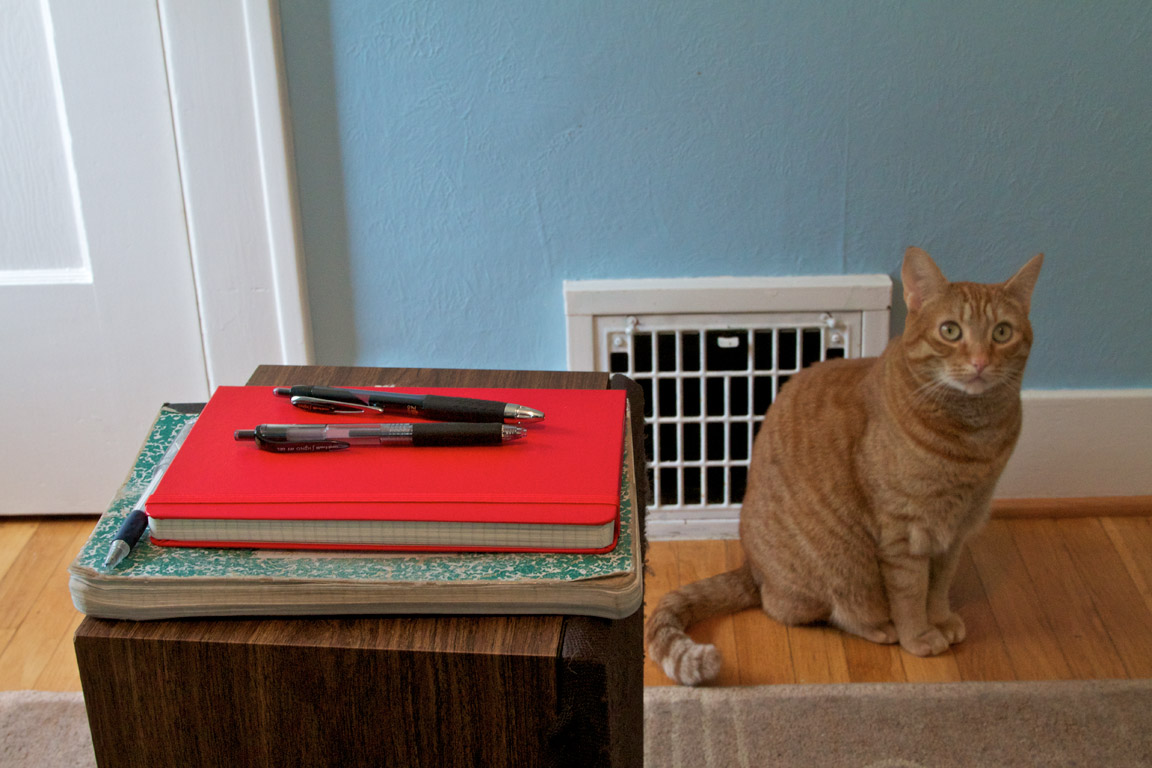
The new notebook and pens sitting on the old, both sitting in front of a sitting Sam
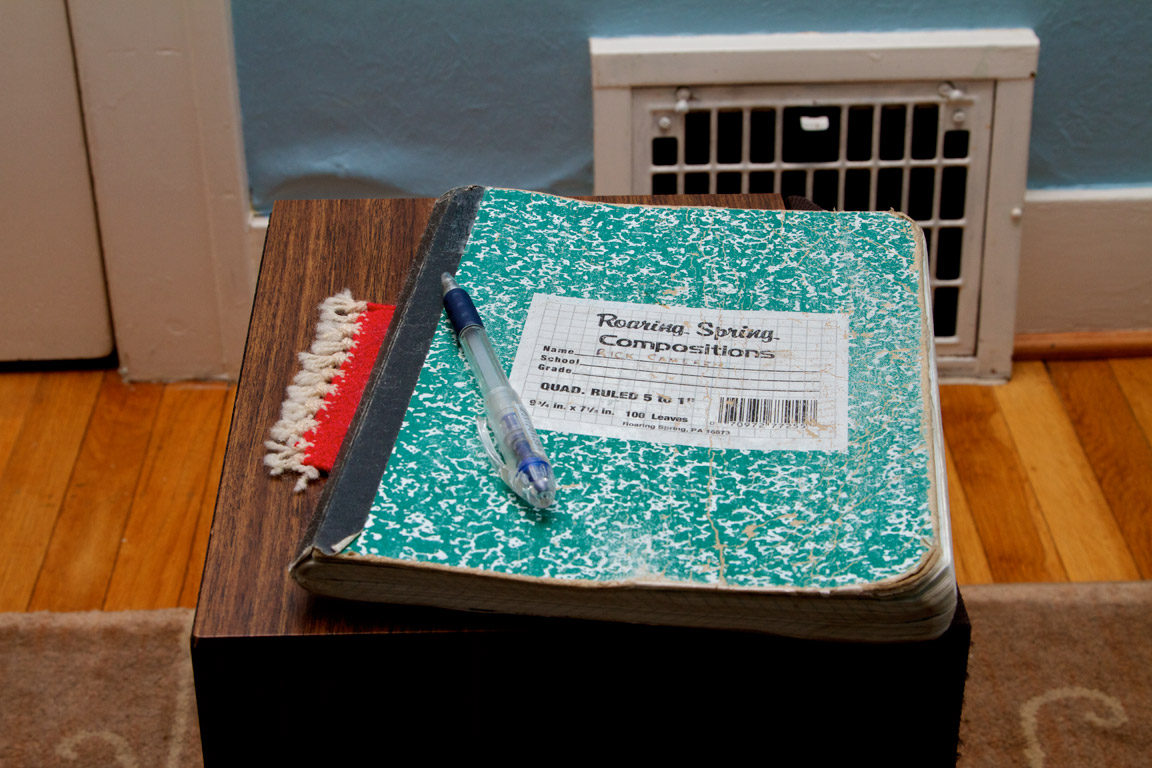
I taped the edges of the cardboard covers when they started shredding but otherwise the notebook has held up well to over seven years of hard use. One of my better $2 investments.
I used to keep notes about my hiking and photography outings on loose sheets of paper that were quickly lost. One day while in Office Depot I grabbed an inexpensive notebook to see if I’d prefer keeping my notes in more permanent form. I think it may have cost all of two dollars. It’s a simple notebook from Roaring Spring Compositions, designed for children I’d guess given that the cover asks for your school and grade. It was quad ruled which I liked as I tend to wander without the guiding hand of the grid. It measures 9 3/4″ by 7 1/2″ and was made in the USA, presumably in Roaring Spring, PA.
My first entry is from December 28, 2003 and starts with a visit to a National Wildlife Refuge — but not Ridgefield as you might expect. No, this was Colusa National Wildlife Refuge, part of the Sacramento NWR complex down in California. My wife and I spent Christmas with family in California and she flew back while I took the Subaru and planned to visit the redwoods and the refuges near the border.
After a quick visit to Colusa I drove the auto tour at Sacramento NWR, but only once as a sudden snowstorm was blowing in and I needed to hurry to get across the coast range to the redwoods. I didn’t make it too far before discretion proved the better part of valor and I retreated to spend a couple of days in a hotel in Redding. Once I-5 reopened and it was safe to drive back home, I canceled the trip and arrived at our house just hours before a nasty ice storm hit Portland.
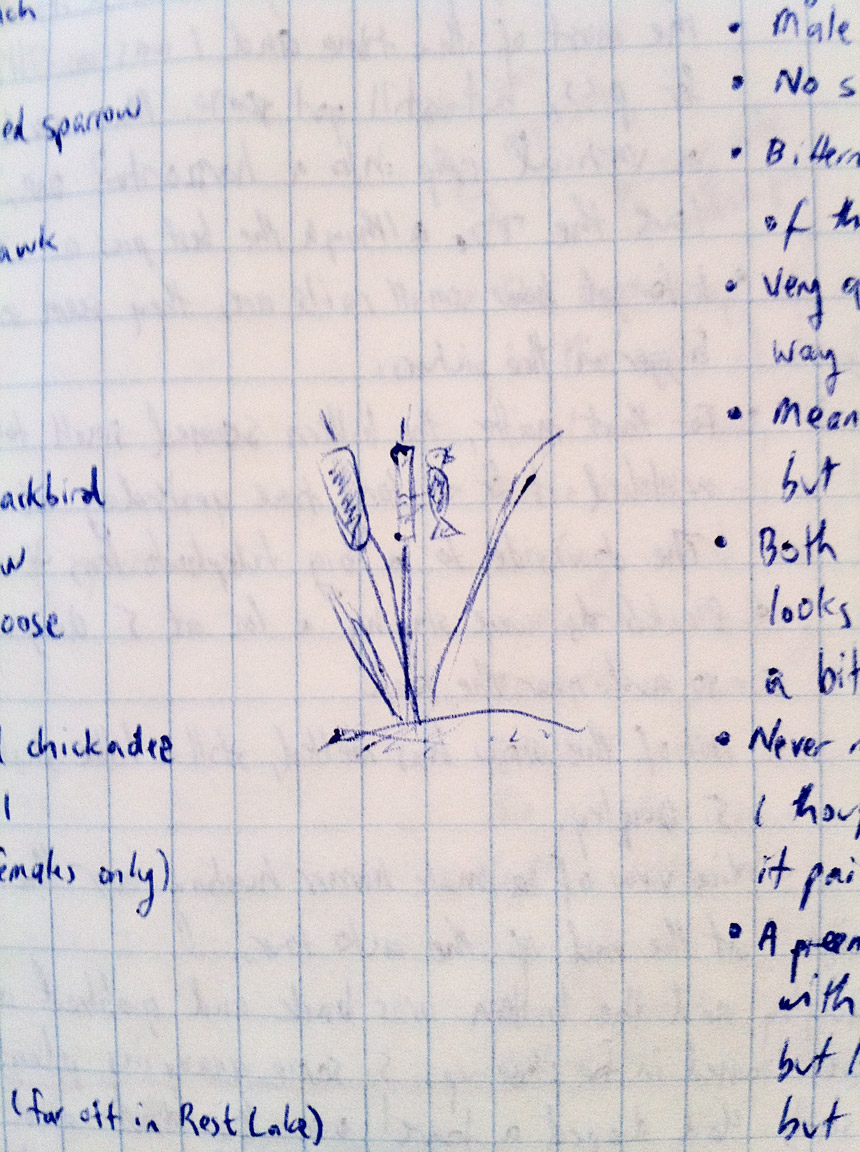
For each visit I keep track of what animals I see and I try to make notes about how the day went, although some days I never get round to filling in the notes. Every once in a while I’ll make a little drawing in the notebook, but rarely so, for even a caveman of Lascaux once called them “rather crude”, and he was being charitable.
Look at this drawing and you can almost hear the red-winged blackbird singing in the cattails. It helps if you close your eyes while looking.
Flip over a few pages from the aborted California trip and there’s our first visit to Olympic and Mount Rainier National Parks in the summer of 2004. Then comes my first real visit to Yellowstone a few weeks later (we visited for a few hours when my wife moved to Oregon but that hardly counts).
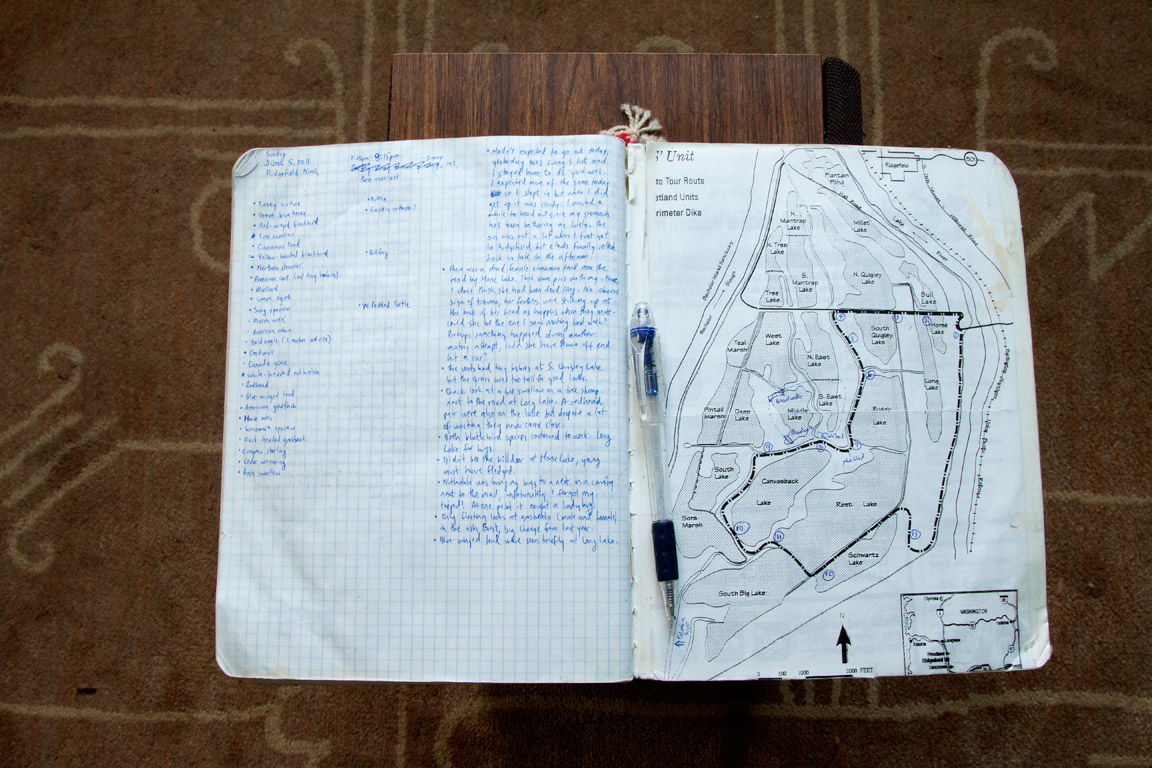
There’s my first (and only) visit to Japan in 2005, then my first visit to Huntington Beach State Park in South Carolina a few months later that at long last re-introduced me to alligators. And a few months later a return to Yellowstone and my first visit to the Tetons. In between the big trips most of the pages are scrawled full of visits to Ridgefield, long ago I taped a map of the refuge to the inside of the back cover to help me keep straight the small lakes along the auto tour.
Flip a bit more and there’s my trip to Yellowstone and the Tetons in 2006. Another visit to Huntington Beach in December of that year, my first time out after my stepfather passed away unexpectedly, when the quiet serenity of the off-season provided much needed comfort.
Another visit to Yellowstone and the Tetons in the fall of 2007 which was my last. Good grief has it really been that long since I’ve been there? In the fall of 2008 I went to Rainier and the Olympics instead and saw my first hoary and Olympic marmots, continuing an obsession ignited by Yellowstone’s yellow-bellied marmots.
This entry from Yellowstone starts out with "WHAT A DAY!", and what a day it was, for I saw my first (and only) wolf up close.
In 2009 instead of my usual fall hiking trip I took a spring trip to the redwoods in California, my first visit since the snowstorm aborted my attempt back in 2003. The big trip of 2010 was our visit to Maine to spread my mother-in-law’s ashes.
Where will 2011’s big trip be? Wherever it will be, it won’t be recorded in this notebook. My June 5th visit to Ridgefield filled the final page.
Fittingly the journal closes out with a visit to and map of one of my favorite places on the earth, the unassuming little auto tour at Ridgefield.
Winter is a good time for viewing eagles at Ridgefield but this young bald eagle at Schwartz Lake was the only eagle I saw during my visit on January 16th. I didn’t expect to have much time for pictures when I pulled the car over as I feared the eagle would spook when the next car came past. But the steady rain kept traffic on the auto tour so low that no one else came by and since the eagle was in no hurry, I was able to watch it for quite a while. Most of the time it just stood on a submerged log, but a few times it leaned down for a drink before finally flying off to a nearby tree.
Schwartz Lake (like most lakes at Ridgefield) is quite small and shallow since it is really just a flooded field. The water levels of many of the lakes are managed to mimic the floodplains of the Columbia before the dams were built, flooding during the winter and drying out by summer.
Our good and gentle queen turned ten back in March. We’ve had Scout since she was a kitten so she’s been by my side the entire decade. She is a queen that rules with a soft furry fist. Her monarchy is characterized by a modified form of laissez-faire — everyone is welcome to do whatever they want as long as it doesn’t interfere with what she wants.
For example, if Sam is sleeping on my lap and she wants to snuggle too, he’s welcome to stay where he is just so long as he doesn’t mind when she steps on him as she goes through her rituals of getting petted before she’ll lie down. I try to tell her that a good queen doesn’t walk all over the little people but this subtlety is lost on her.
She also considers one of the cat beds hers. The others are welcome to sleep in it as long as they get up when she wants it. When they don’t, she gives them the evil eye for a few moments. If that doesn’t work, she comes over and starts giving me the business until I evict them.
Yes, she can be a little grumpus. But she’s my little grumpus. I wouldn’t trade her for the world.
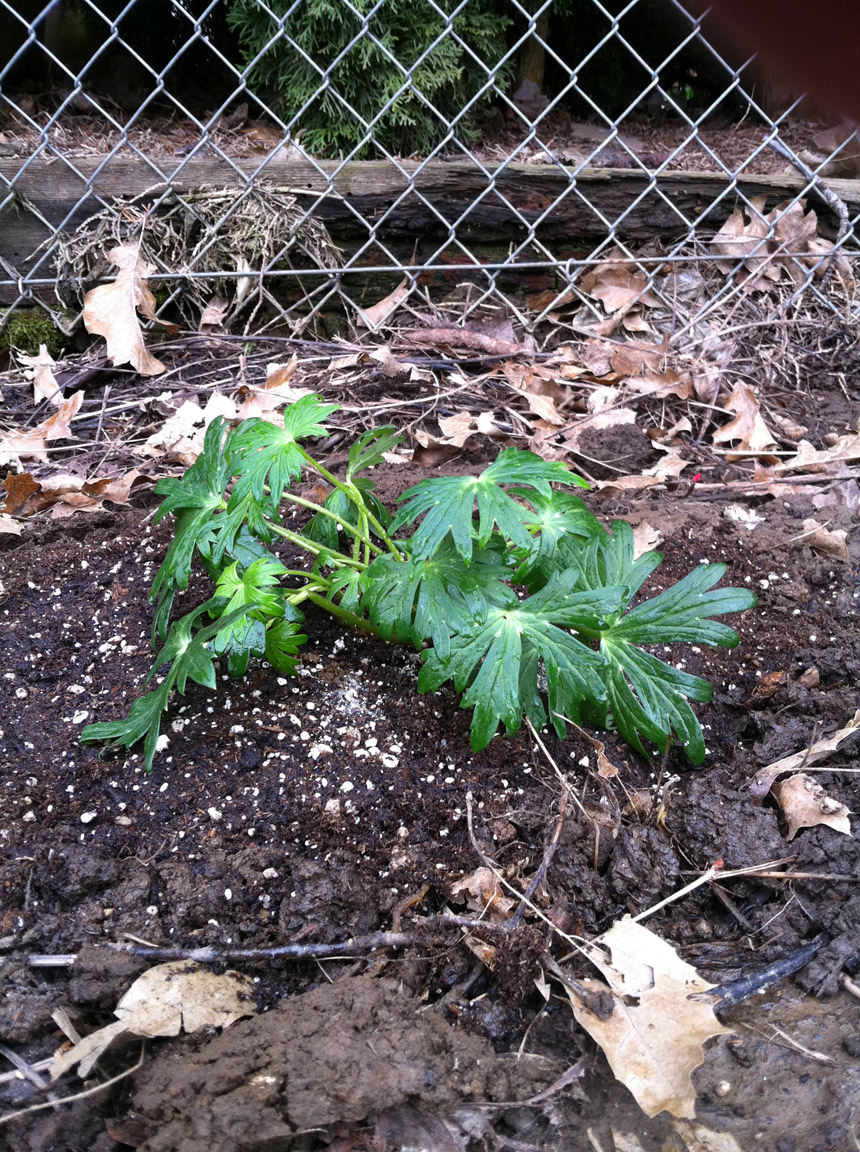
Thankfully I took a quick snapshot with my iPhone after planting our new larkspur as the slugs didn’t take long to strip it bare.
We have a little slice of the Columbia River Gorge taking root in our backyard in Portland. One of my wife’s colleagues does research on a larkspur species that grows on the western side of the gorge, Delphinium trolliifolium, and gave us one of his research subjects when he was done with it. I’m not sure of the exact nature of his research, but perhaps it’s to see if bigfoot would rather eat larkspurs or decorate its den with them.
Our particular plant was grown from seeds collected at the trailhead to Angel’s Rest, one of my favorite trails in the Gorge, so I was happy to give it a home in a shady section of our yard. The slugs were happy too as they quickly devoured it. It normally blooms in late March to early April so the hungry little gastropods ruined our chance for flowers this year, but there’s hope for the next. I put some slug bait around it and now there is a lot of new growth springing up. I don’t usually put out slug bait, even the new safer kind as I prefer the live-and-let-live approach, but it was the only way to try and save the plant.
The slugs may have done in the lobelia as well that we planted last fall as part of the new hummingbird garden in memory of my mother-in-law, as it hasn’t poked up out of the earth yet. One of the salvias has also shown no signs of life, perhaps the unusually wet winter and spring did it in, but there have been at least some signs of life from all of the other new arrivals. The new dogwood in particular did just fine during the winter and is now leafing out like crazy.
Some of the other new plants are showing signs of late night devourings as well, so perhaps I need to apply the slug bait a little more liberally until the plants are better established. I think most of our garden slugs aren’t native, so there’s that at least.
I was also pleased to see that the handful of ferns I transplanted from the side of the house are unrolling new fronds, I was most worried about the one with delicate lace-like fronds but it seems to be doing the best of all of them. Between the ferns, the trillium doing the best it ever has, the new hostas sprouting up, and the new larkspur hopefully making a comeback, Redwood Corner is starting to take shape.
An unopened bottle of mango lemonade has been sitting in the fridge for weeks, unopened because despite many attempts I couldn’t get the cap to let loose its grip. Last night I gave it one more go and with a great effort and a little grunting finally proved the master. I turned with liberated cap in hand and looked for others to share in my glorious victory. But Sam and Emma were chasing each other around the living room, Scout was asleep in her warm bed, and Ellie looked on only in the hope that this would somehow lead to hedgehogging.
Nevertheless I quietly poured my juice and lifted my glass to the heavens. Are you listening, universe? This is Boolie and he will not be denied!
This killdeer was chirping to its mate who was a few feet off to its right near the edge of the refuge parking lot. I had never been so close to these lovely birds and had to use some extension tubes to allow my camera to focus that close. Taken from the window of my car.
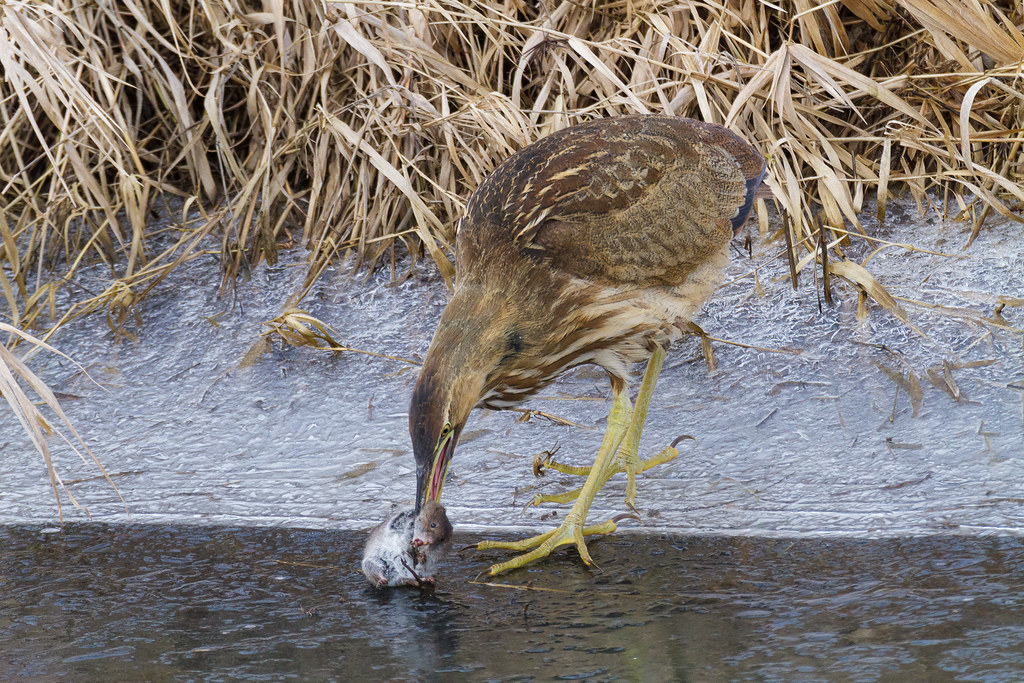
Although I failed in my quest to find a bittern in the frost on the last day of 2010, the first day of 2011 rewarded me with a bittern on the ice — a hunting bittern on the ice. The day started out promising when I glimpsed a blacktail buck on the drive down through the canyon and onto the refuge at Ridgefield, but after putting on a show the day before the rest of the animals seemed to be sleeping in. While the early hours weren’t crowded, as the morning wore on the visitors picked up rapidly and the big lens attracted a small crowd whenever I stopped.
On the far side of the refuge, I like to drive slowly along Rest Lake to look for bitterns, so I pulled over to let an approaching car past so that I could move at my own pace. Even as I was pulling over I noticed this bittern down below in the frozen channel and settled in to watch. Within moments the bittern struck into the grass and brought out this terrified vole. Bitterns often like to dunk their prey in the water and so it gingerly stepped down the rim of ice, struggling not to slip, and then dunked the vole into the water. Or tried to at least, but failed, since the water in this section was still frozen. It seemed mystified for a moment and stood motionless before eating its meal undunked.
After taking a few environmental portraits of the bittern on the ice, I moved ahead just slightly to another nice location and waited for the bittern to come past. But a Land Rover came up behind me and the couple got out of their car (a no-no on the auto tour during the winter) to set up their scope to view the distant ducks and swans. Not surprisingly I didn’t see the bittern again.
When I got to the end of the auto tour, I was going to go around again but my heart sank when I saw a nearly solid line of cars between Horse and South Quigley Lakes. I learned my lesson from Christmas day, when I should have left when it got over-crowded but didn’t, and headed home. Ellie got an extra walk and playtime in the park, and extra hedgehogging as well, so all-in-all a fantastic start to the year for everyone but the vole.
We adopted our sweet girl two years ago and, since we don’t know her real birthday, we celebrate it today as well. She was five when we adopted her and so now turns seven. This picture is from June when she was still recuperating from her surgery, this is the look I get in between sleeping and snuggling and hedgehogging. Speaking of which, someone has been patiently waiting all night for me to finish my chores, so I’d better go.







 Boolie