A Matter of Trust

A black bear with brown fur browses on huckleberries near the Skyline Trail in the Paradise area of Mount Rainier National Park

Another picture of my favorite bear from my trip to Washington. I watched it graze on huckleberries for an hour in a meadow below the Skyline Trail in Mount Rainier National Park, so it was already pretty comfortable with me when it started moving up towards the trail. I could tell where it wanted to go so I moved down the trail in the opposite direction to give it plenty of space.

I assumed it would continue higher up the hill but instead it started walking down the trail in the same direction I hoped to head. I followed at a long enough distance to keep it in its comfort zone, so mostly I had a view of its rear end. I should post a gallery of animal rear ends I’ve taken over the years, keeping an animal in its comfort zone doesn’t necessarily lead to the best pictures 😉

I’ve experienced this in my own home, Scout has liked to sleep on me ever since she was a little kitten, but unlike Templeton she often sleeps with her rear end pointed towards my face. Sometimes to the point that she actually sits on my face, when she was younger I woke up many a time getting smothered by a little kitten butt. My wife convinced me to take it as a badge of honor, that she was showing trust by exposing her most vulnerable position, so I’ve adopted the same philosophy to animals on the trails. Missed picture opportunities are a small price to pay for earning their trust.

In this case though, the bear’s desire to fatten up for the winter worked to my advantage, it turned aside for a moment to grab a few more huckleberries before continuing down the trail.

You … You … You Are Going to Share Your Mango, Aren’t You?

An American pika with a twig in its mouth on the Palisades Lakes Trail in the Sunrise area of Mount Rainier National Park

Ever since first seeing pikas in the Tetons, I always choose some of my hikes on my Wyoming trips to go into terrain where I might glimpse these little mammals. So it should be no surprise that I chose many of my hikes on my trip to Mount Rainier to put me into the land of marmots and pikas. At first I had only near misses at pictures as pikas scampered along the Sourdough Ridge Trail, dragging plants down into their homes under the rocks. But at the end of my first full day of hiking, the Palisades Lakes Trail blessed me in abundance.

I stopped at a talus field near the end of the trail for some water and snacks, hoping that a pika might poke its head out from the rocks while I rested. I had heard but not seen them in the area as I passed by at the start of the hike, but it wasn’t long after I opened my water bottle that this pika first appeared. It was busy adding plants to its cache under the rocks, occasionally stopping to eat a little. I took a number of pictures while it was active, spending almost half an hour watching it as it gathered food. During the stretches where it was out of sight, I swapped the camera for my water bottles.

I took me a while to quench my thirst as I picked up the camera any time the pika popped up, but eventually during a quiet stretch I turned my attention to my hunger and brought out my bag of snacks. We had picked up some dried mango slices shortly before I left, I had never tried them before but they immediately became my favorite treat of the trip. As I started into the mango the pika suddenly reappeared, so I closed up the bag and set it a nearby rock before picking up the camera for more pictures.

The pika kept ducking in and out of the rocks, classic pika behavior, but I could hardly believe my eyes when I realized that the pika was actually working its way in my direction. The little thing was soon too close for pictures so I just stood baffled by such a close encounter. I soon realized its intention as it shuffled over towards my snack bag and sniffed around. I eased over and took the bag away, having just watched it store away a variety of plant life I feared my dried fruit was about to be added to the cache and enjoyed all winter long by my furry friend.

It hung around for a little while, almost at arm’s reach but always with an escape route into the rocks. The timing was probably coincidence, but when I finished the mango it either lost interest in the remaining fruit or realized I wasn’t going to share and headed back up the slope. I finished my snack and hoped for more pictures, but it wasn’t long before the pika went under for good and I continued up the trail.

I couldn’t help but feel guilty about not sharing my bounty, given that it posed for so many pictures, but better to keep them wild. Besides I knew from our time together that it wasn’t going to go hungry this winter, even if it was going to have to miss out on the mango.
Timing

A black bear with brown fur dines on huckleberries along the Skyline Trail in the Paradise area of Mount Rainier National Park

I’ve been taking a hiking trip each fall, in Wyoming this meant that not only did I miss the summer crowds, but also got fall colors and the elk rut. But it also meant the weather can be hit and miss, such as last year when a snowstorm forced me to cut my trip short.

My fear when I started my Washington trip was that I had waited one week too long. After nice sunny weather the previous week, the rain arrived heavily on the first day, then was off and on for much of the trip. Fortunately although the higher elevations got an occasional dusting of snow, it stayed off the roads so I didn’t have any travel problems.

The occasional rain did mean I often had overcast skies, which is what I want during the day for wildlife photography. The sun did shine inconveniently at times, such as when I was watching the large marmot colony at the end of the Summerland Trail in Mount Rainier NP or when I came across a bear on the Beaver Valley Trail in Olympic NP.

I had overcast skies and rain when I came across this young bear on the Skyline Trail in Mount Rainier National Park, the most beautiful bear I’ve ever seen. Many of the pictures didn’t come out very well, the light was low and the rain sometimes heavy and my tripod was in my hotel room (intentionally, it was a long hike with a lot of elevation change). The bear was nose down in the huckleberry bushes and rarely raised its head, but it stopped to look at me once and you can see the seeds that have latched on to its head.

And that was the best part of the timing of the trip, getting to watch a variety of animals preparing for the long winter. I doubt I would have seen so many bears if they weren’t fattening themselves on the huckleberries, and also I spent a lot of time watching marmots and pikas gathering food. The marmots were putting on weight before hibernating for the winter, while the pikas (which don’t hibernate) were creating large stores of food above or under the rocks that they will feed on during the winter.

So despite my early fears, my timing turned out to be perfect.

White Spots

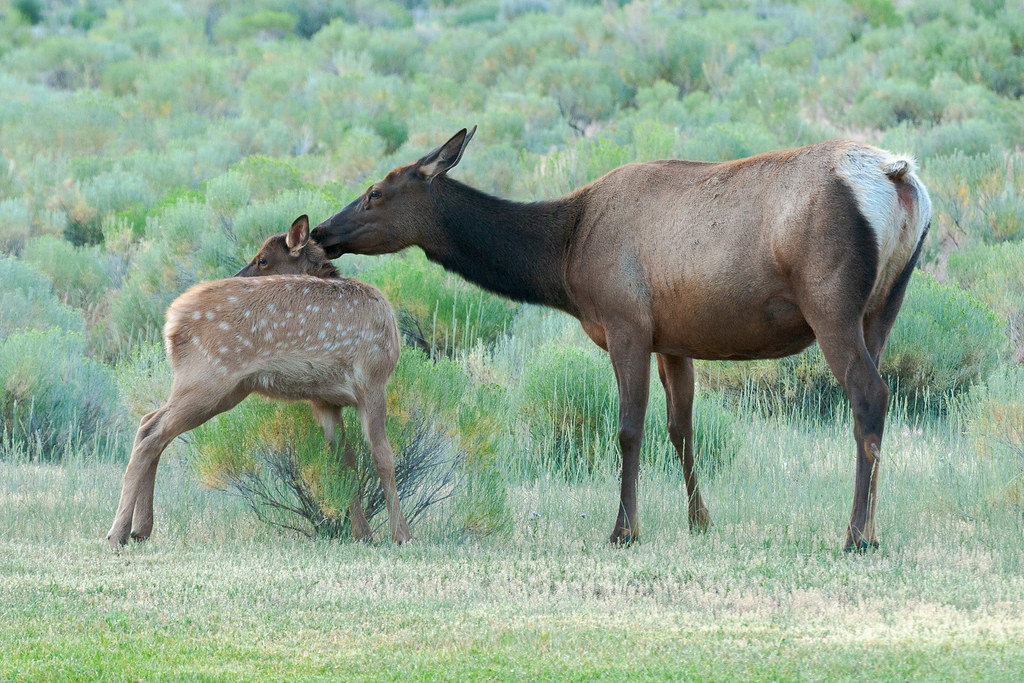
A female elk nuzzles her calf in Mammoth Hot Springs in Yellowstone National Park in July 2004

A mother nuzzles its white-spotted calf at sunrise near Mammoth Hot Springs at Yellowstone National Park. This was my first real visit to the park in the summer of 2004 and was taken on my last day in the park. Despite wanting to get up early every day during the visit, I only managed to do it on the last day. I also saw the most animals and got my best pictures, I lesson I didn’t forget. It seemed like Mother’s Day, as within a few minutes I saw mothers and young not only of elk but also bison, black bears, and moose.

Fitful Sleep

An elk bull is mostly hidden apart from his antlers as he sleeps in the tall grasses of a meadow at Yellowstone National Park

There were several aspects I wanted to capture in this picture of an elk in Yellowstone National Park. There’s a slightly comical aspect in that the sleeping bull is almost invisible save for his antlers which stick up out of the tall grass and completely betray his presence. The bull isn’t really trying to hide, but I wondered if he wouldn’t have preferred at that moment to be able to just take the antlers off while he slept, if only so he could lay his head wherever and however he liked.

I also wanted to convey the exhaustion the bulls feel at the end of the rut. He slept most of the time I watched him, but couldn’t resist raising his head and answering the call whenever another bull bugled in the distance. Fortunately all of the people watching him kept their distance so he was able to rest in the quiet periods. A couple of weeks before I visited, one of the bulls had its neck snapped while it was sparring with one of the other bulls. These fights usually aren’t fatal, but add in disease, predators, and the long winter, and I do wonder how many of the animals I see will still be around come spring.