No Time to Rest

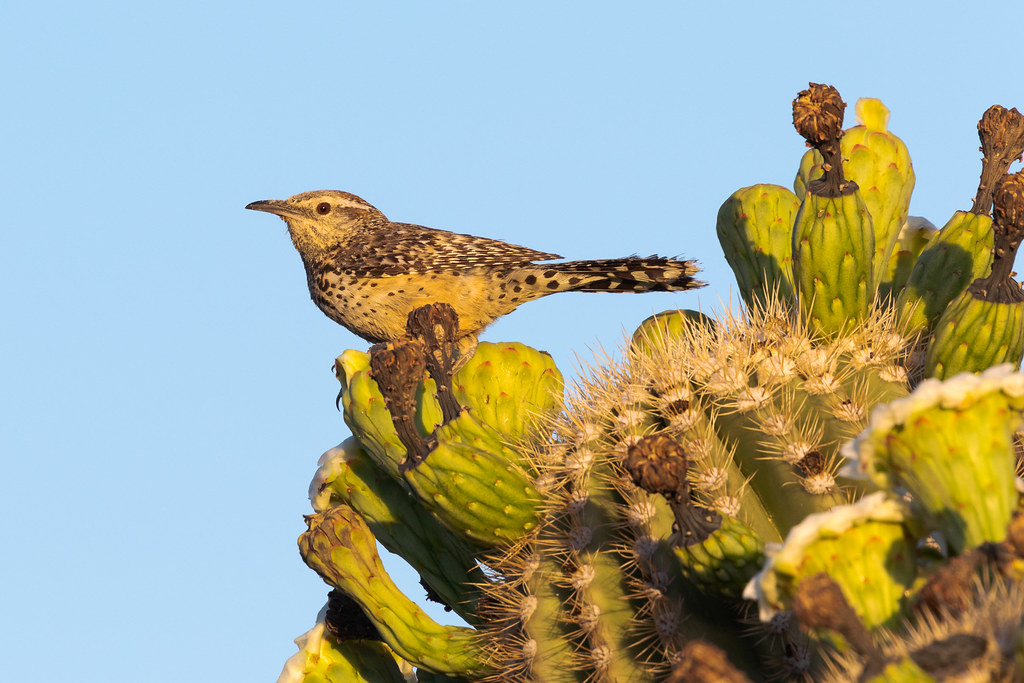
A cactus wren, its face covered in pollen, pauses on a saguaro while feeding its young

A cactus wren paused momentarily above its nest (not visible) while it and its mate constantly flew in and out feeding insects to their young. They were comfortable with my presence so I was able to watch them for a while as the sun quickly rose but I didn’t take many pictures since they paused so briefly. It’s face is covered in pollen from saguaro blossoms, I had seen several other species of birds face down in the flowers but the wrens seemed too busy feeding their young to feed themselves. The next week I did witness one quickly eating from a blossom but they didn’t take the time to gorge themselves like the finches and doves and quail.

As worn out as I am I’ve been getting up before sunrise to hike on all my days off as these springtime activities will soon be but a memory. The heat is quickly rising, summer will quickly follow, then it will be time to rest. Or at least nap, I’d still like to hike as much as the temperatures allow.

Calling Me Home

A male Gambel's quail sits atop spent saguaro blossoms in the Brown's Ranch section of McDowell Sonoran Preserve in Scottsdale, Arizona

One of the birds I most wanted to photograph when we arrived in Arizona was the Gambel’s quail. Not because they are rare – we saw them in the neighborhood when we were looking at our rental house – but because they called me home. It was our vacation in New Mexico a decade ago that got me excited about living in the Southwest, and my encounter with Gambel’s quail there was one of the highlights of the trip, their serenade at sunrise. So it was a special delight to photograph this male and female up on the saguaros as the sun rose, dining on the cactus blossoms, in our shared desert home. Home in a larger sense, though I see them every day in my backyard these quail were at Brown’s Ranch in McDowell Sonoran Preserve.

A female Gambel's quail eats from saguaro blossoms in the Brown's Ranch section of McDowell Sonoran Preserve in Scottsdale, Arizona

Almost Ended in Tears

A Harris's antelope squirrel in a bush looks out over the Sonoran Desert along the Vaquero Trail in the Brown's Ranch section of McDowell Sonoran Preserve in Scottsdale, Arizona

Moving to Arizona has required a number of minor adjustments to my clothing and gear. I dress up a bit more for work here so I had to get all new work clothes. Our rental house has a pool which meant ordering swimsuits, swim shirts, goggles, and towels. The desert meant meant a new hat designed to shed heat (and a second one I just ordered to stay in the car for days like today when I forget mine), new hiking shoes, new socks, and an extra pair of hiking pants. More water bottles. Shorts to wear around the house.

I think it’s about to force one more change, a more major one, at least in terms of expense. On the auto tour at Ridgefield I mostly used my big 500mm telephoto lens, but that’s way too heavy for hiking for hours in the desert. I’ve been using a lens I adore, my Canon 100-400mm zoom, and the Canon 1.4x teleconverter. The weak link is the camera I have to attach to, my Canon 7D II, a camera which in general I like apart from it being an SLR instead of mirrorless, the lack of an articulating touch screen, the weight, and the poor video (I do like it, it has many good points). But now there’s this: the autofocus works great with the 100-400 by itself but not with the teleconverter attached.

It’s not useless, and I’d put up with it if I had no choice, but a while back Sony introduced a similar 100-400 lens. The autofocus on my Sony camera would work well with the lens even with their teleconverter attached, plus I’d avoid the problem that almost cost me this shot: the optical viewfinder. I had been shooting this Harris’s antelope squirrel in the shade when it bounded across the trail and climbed this bush to survey the landscape. I was shooting in manual to deal with the difficult exposure but forget to change the settings for the sunlight the squirrel was now in. This would have been obvious in a mirrorless camera, fortunately I eventually realized my mistake and got a picture before it climbed back down.

It would mean switching to the Canon for wider angles until I have a second Sony body (I’d wait until they bring out an upgraded version of what I have now), which will mean more weight in the short term, but in the long term both less weight and a better fit for how I hike in the desert.

Tails to Tell

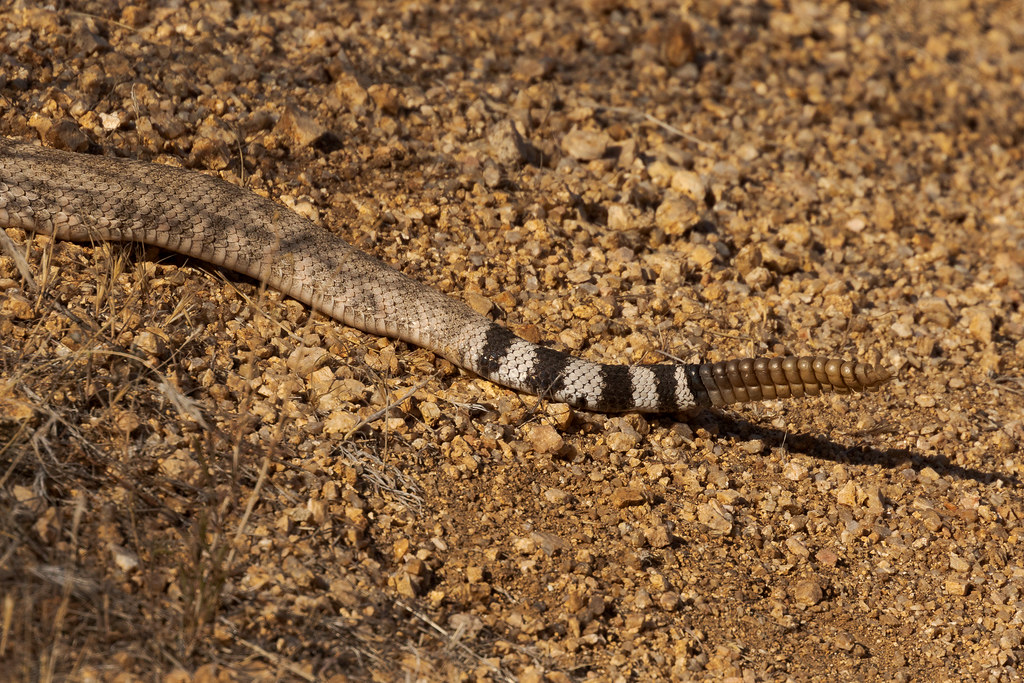
The distinctive tail of a western diamondback rattlesnake

Last week I saw my first Gila monster but got my best look at its tail as it slowly walked into the bushes. This morning I saw my first western diamondback rattlesnake but also got my best look at its distinctive tail as it slowly slithered into the bushes. Thankfully I didn’t spook it, as I crested a small hill I saw it far enough away that it wasn’t startled and I kept a respectful distance. I had already put my camera away but had time to take off my backpack and get the camera out and take a picture of that beautiful tail.

Morning Glory

A Gila monster wanders into the brush beside the Cholla Mountain Loop Trail in the Brown's Ranch section of McDowell Sonoran Preserve in Scottsdale, Arizona

I hesitate to post this as not only is it not a good picture but you’re only seeing the tail end (ahem) of a brief encounter Saturday morning. But this brief encounter already joins my pantheon of favorite hiking moments, as the one creature I wanted to see in Arizona above all others, but the one I knew was rare to see, was the Gila monster. I arrived at Brown’s Ranch before sunrise Saturday morning as I have many times the past couple of months, this section of McDowell Sonoran Preserve has been the place I’ve visited most frequently. I hoped to photograph Gambel’s quail up on the saguaros in the lovely morning light but I found something unexpected when I arrived at the trailhead: clouds.

I’m used to clouds. I’m from Oregon. But I’ve gotten so used to blue skies here in the desert that I’ve only been checking temperatures before I hike, not cloud cover. The clouds were thick (for Arizona, not for Oregon), thick enough to snuff out the morning light, and that meant a change of plans. Instead of looking for wildlife along familiar trails, I immediately headed out eastward on the Chuckwagon Trail. I had hiked it the week before with the sun in my eyes so I took advantage of the cloud cover to shoot patterns in the plants and rocks along the trail and had a grand time.

I wasn’t seeing much wildlife, not even a lizard, and jokingly thought to myself that I hadn’t been in Arizona long enough to know who to complain to about that. I hiked further on the trails this time, up to Cathedral Rock, and turned around to try some different trails on the route back. I packed up my telephoto lens as the sun was getting a bit bright, swapped my tripod for my hiking poles, and set off to explore.

I didn’t make it very far. There it was crossing the trail in front of me, one of the most beautiful creatures I’ve ever seen, this Gila monster. As slowly as it walked – walked? waddled would be a better term – and as colorful as it was, it soon disappeared into the desert brush. I grabbed my little Sony out of my camera bag and got a quick picture before it was gone from sight, but there was no time to set the focus on its head. Then it was gone.

We only shared a few seconds together but I’ll remember those seconds for a lifetime. I returned to Brown’s Ranch this morning but the clouds did not. I found my quail on a saguaro, and more besides. The desert is full of wonders, but this wonder, this monster, I hope to meet again.

Brown’s Ranch

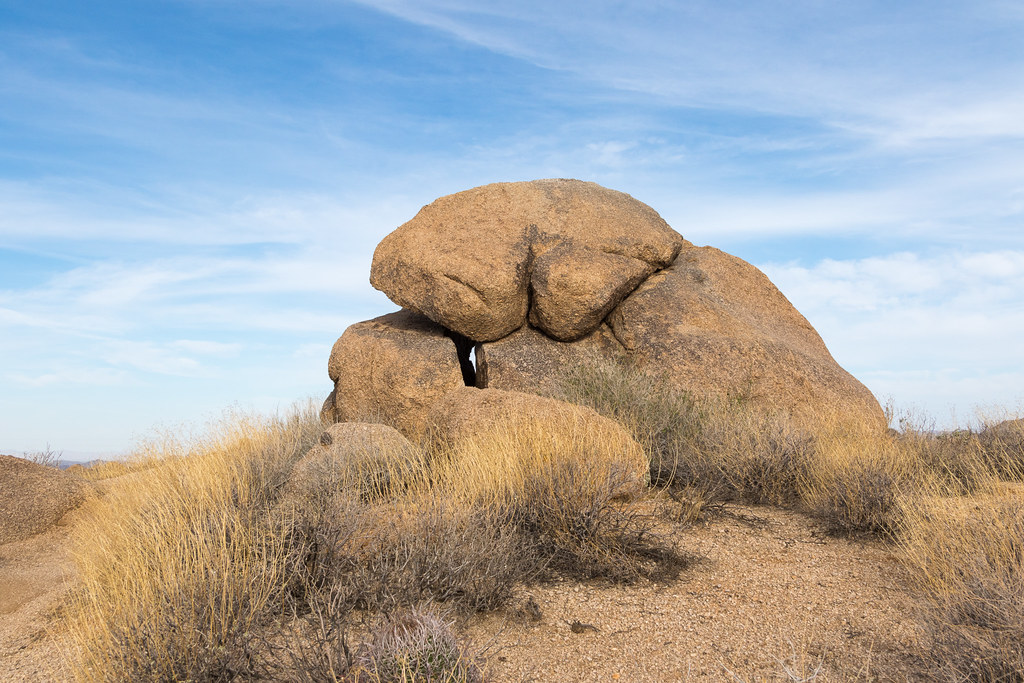
A scenic view of large rocks in the desert in the Brown's Ranch section of McDowell Sonoran Preserve in Scottsdale, Arizona

The Brown’s Ranch section of McDowell Sonoran Preserve has quickly become one of my favorite local places to hike. It’s far too soon to say if it will become my Ridgefield – the default place I go when I want to go out – but it has been a great place to explore and learn about the desert in the spring. I’m assuming it was named after someone named Brown and not because everything is brown, though both would be apt.

Not the Usual Suspects

A young male Bullock's oriole perches atop a blooming saguaro cactus in the Brown's Ranch section of McDowell Sonoran Preserve in Scottsdale, Arizona

In my short time here there are a handful of birds I’ve gotten used to seeing on the saguaros: Gila woodpeckers, gilded flickers, house finches, cactus wrens, and curve-billed thrashers. But I sometimes see more than the usual suspects, such as this splash of color that momentarily swooped into view early Saturday morning. He’s a young Bullock’s oriole, he’ll be even more colorful and vibrant in a year. I’ve only see this species a couple of times before, both during my years in Portland, so here’s hoping we meet more often in Arizona.

Home in the Desert

A black-tailed jackrabbit sits in the Sonoran Desert in the Brown's Ranch section of McDowell Sonoran Preserve in Scottsdale, Arizona

As we make our home in the desert it is painfully clear to me as I hike, suited up with bottles of water and protective sun gear, that I will never be at home in the desert, not like they are, the animals who live here. This black-tailed jackrabbit can leap 5 or 10 feet at a time and reach speeds up to 40 mph, but on this morning it casually sauntered off into its desert home.