Comings and Goings

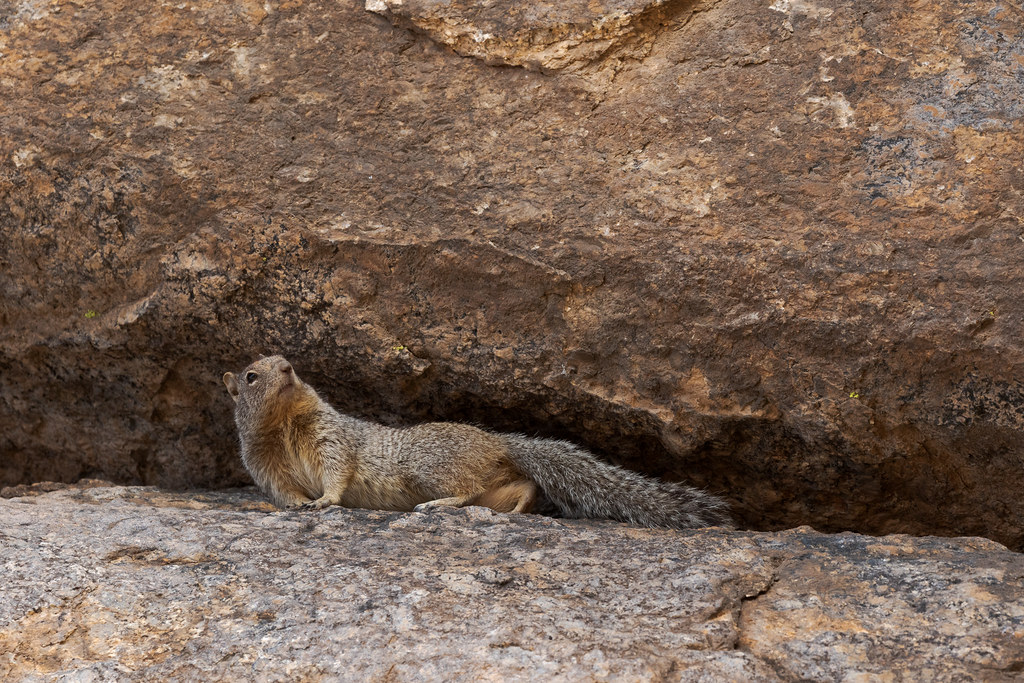
Two Harris's antelope squirrels look out from their rocky perch along the Vaquero Trail in the Brown's Ranch section of McDowell Sonoran Preserve in Scottsdale, Arizona

I first learned of the Harris’s antelope squirrel from a sign on the Bajada Nature Trail a couple of weeks after we moved here, and funnily enough got my first brief look at one just a few minutes later. After seeing one of the little ground squirrels up close on the Vaquero Trail I did a little research to learn if their home range was small (it is) and if they liked to look out from higher vantage points like the one I had observed (they do).

Knowing that, I decided to hike the Vaquero Trail again and kept my eyes peeled when I approached the area of my previous sighting. And there it was up on the rocks! Up on a small hill it had a complete view of its surroundings and would have seen me before I saw it. Unfortunately I had forgotten my 100-400mm lens at home but I returned the next morning and there it was again! I had settled on using my Canon 100-400mm lens with a 1.4X teleconverter as my wildlife hiking setup, which presented a problem, as on my Canon body I could only use the center focus point, and the autofocus wasn’t that reliable in low light. Attached to my Sony body the autofocus was sometimes quick but not reliably, but I could also use it for video and for manual focus.

I shot the squirrel with both setups, starting with the Canon before switching to the Sony. Fortunately the AF was working well when a second squirrel popped up behind the first! The experience cinched a decision I had been mulling for a while now and that afternoon my wife and I went down to Tempe Camera and purchased the Sony 100-400mm lens and Sony 1.4X teleconverter. The new lens proved its mettle as soon as I arrived at the preserve the next morning, and on multiple hikes since, but those are stories for another day.

Almost Ended in Tears

A Harris's antelope squirrel in a bush looks out over the Sonoran Desert along the Vaquero Trail in the Brown's Ranch section of McDowell Sonoran Preserve in Scottsdale, Arizona

Moving to Arizona has required a number of minor adjustments to my clothing and gear. I dress up a bit more for work here so I had to get all new work clothes. Our rental house has a pool which meant ordering swimsuits, swim shirts, goggles, and towels. The desert meant meant a new hat designed to shed heat (and a second one I just ordered to stay in the car for days like today when I forget mine), new hiking shoes, new socks, and an extra pair of hiking pants. More water bottles. Shorts to wear around the house.

I think it’s about to force one more change, a more major one, at least in terms of expense. On the auto tour at Ridgefield I mostly used my big 500mm telephoto lens, but that’s way too heavy for hiking for hours in the desert. I’ve been using a lens I adore, my Canon 100-400mm zoom, and the Canon 1.4x teleconverter. The weak link is the camera I have to attach to, my Canon 7D II, a camera which in general I like apart from it being an SLR instead of mirrorless, the lack of an articulating touch screen, the weight, and the poor video (I do like it, it has many good points). But now there’s this: the autofocus works great with the 100-400 by itself but not with the teleconverter attached.

It’s not useless, and I’d put up with it if I had no choice, but a while back Sony introduced a similar 100-400 lens. The autofocus on my Sony camera would work well with the lens even with their teleconverter attached, plus I’d avoid the problem that almost cost me this shot: the optical viewfinder. I had been shooting this Harris’s antelope squirrel in the shade when it bounded across the trail and climbed this bush to survey the landscape. I was shooting in manual to deal with the difficult exposure but forget to change the settings for the sunlight the squirrel was now in. This would have been obvious in a mirrorless camera, fortunately I eventually realized my mistake and got a picture before it climbed back down.

It would mean switching to the Canon for wider angles until I have a second Sony body (I’d wait until they bring out an upgraded version of what I have now), which will mean more weight in the short term, but in the long term both less weight and a better fit for how I hike in the desert.

Home in the Desert

A black-tailed jackrabbit sits in the Sonoran Desert in the Brown's Ranch section of McDowell Sonoran Preserve in Scottsdale, Arizona

As we make our home in the desert it is painfully clear to me as I hike, suited up with bottles of water and protective sun gear, that I will never be at home in the desert, not like they are, the animals who live here. This black-tailed jackrabbit can leap 5 or 10 feet at a time and reach speeds up to 40 mph, but on this morning it casually sauntered off into its desert home.

Rock Squirrel

A rock squirrel looks out from a crevice in the massive rock formation known as Tom's Thumb in the McDowell Sonoran Preserve in Scottsdale, Arizona

A rock squirrel lives up to its name as it crawls along a crevice in the massive rock formation known as Tom’s Thumb in the McDowell Sonoran Preserve. It had been at the base of the formation but crawled way up into the crevice when hikers with a dog approached. This is not a new species for me, we saw one during our visit to New Mexico a decade ago, but it is nice to be reunited. I owe a lot to that trip, not only because we had a great time but because it got me thinking about moving to the Southwest when looking for a job. I’ll eventually make it over to New Mexico but for now I’m focusing on trails near our home in Scottsdale.

Goodbye Washington, I Love You

A hoary marmot rests on a rock in the late afternoon on the Summerland Trail in the Sunrise area of Mount Rainier National Park

Washington lies across the Columbia River just to our north. I’ve spent a lot of time at Ridgefield and I’ve written about my love for that little refuge but there are two more parks that are near and dear to my heart: Olympic National Park and Mount Rainier National Park. The Olympics literally go from the rugged coast (and tide pools) to rain forests to the snow-capped Olympic mountain range, along with plants and animals endemic to the Olympic peninsula. Rainier has its massive namesake where you can easily hike trails from the lodges and within minutes see pikas and marmots. There are many other trails too, such as the Summerland Trail in the Sunrise area where I met this hoary marmot sunning itself on the rocks. Sometimes I saw bears in both parks, sometimes quite close, sharing the trail with me. Deer and elk, birds, ground squirrels, so much wonderful wildlife living in such breathtaking scenery.

Washington has many other wonders I never explored, I never even visited Seattle for that matter apart from one quick business trip. But I could have explored these parks alone for the rest of my life and never gotten bored. Goodbye, I love you.

Goodbye Oregon, I Love You

A harbor seal watches from the surf near Cobble Beach on a rainy day at Yaquine Head Outstanding Natural Area in Newport, Oregon on October 7, 2017. Original: _L1A8608.CR2

I discovered right away during my interview trip 21 years ago that Oregon was where I belonged. One of the managers found out I liked to hike and took me hiking in the Columbia River Gorge, then the other students and I had the weekend to go out the coast and explore whatever we wanted.

That wonderful Gorge is a half hour drive to the east. My beloved Ridgefield National Wildlife is half an hour to the north (across the river in Washington). Snow-capped Mount Hood and Mount St. Helens are visible from Portland and an easy drive too. Well known for its waterfalls and wetlands and lush forests and rugged coast, all of which I dearly love, there are also high deserts and sand dunes and even redwoods all the way south.

Scenes like this, a curious harbor seal poking up out of the surf at Yaquina Head on a rainy day at the coast, gave me as much pause about moving to Arizona as the summer heat. Oregon has so much to offer, so much that delights me, so much I will miss. Goodbye, I love you.

📷: Canon 7D II | Canon 500mm f/4L IS USM + 1.4x III
🗓️: October 7, 2017

Not for the Squeamish

A female American kestrel eats a mouse at Ridgefield National Wildlife Refuge in Washington

A female American kestrel pulls apart what looks like a mouse at Ridgefield National Wildlife Refuge on a winter morning in 2006. There are a couple of species of mice at the refuge that I’m aware of, deer mice and Pacific jumping mice, but I have no idea which this is (was). Some predators at the refuge swallow their prey whole, while others like kestrels pull them apart and eat just the parts they want and toss aside the rest.

In the Shadows

A coyote pauses in front of a blackberry thicket at Ridgefield National Wildlife Refuge in Washington

A coyote pauses in the shadow of a dense thicket of blackberries, invasives that are widespread across parts of the Pacific Northwest including Ridgefield National Wildlife Refuge in Washington. The coyote was next to the parking lot at the trailhead for the Kiwa Trail, I got to see and hear it howl in the sunlight before it sauntered up to the blackberries and started down the trail (which was closed to humans, I watched the coyote from my car).

Little, But Less So

Two black bear cubs walk single-file up a hillside

Two black bear cubs follow their mother (she’s just out of frame to the right) up a hill in Yellowstone National Park in October 2006. She was very protective of these two, when another adult bear came wandering by she sent them scurrying up a tree without waiting to see if the other bear meant trouble (it didn’t). The cubs were still quite small compared to an adult but were much heavier than they would have been in the spring, a necessity for the winter that arrives early in Yellowstone.

The World of Water

A harbor seal peaks over the waves in the pouring rain at Yaquina Head Outstanding Natural Area in Newport, Oregon on October 7, 2017. Original: _L1A8594.CR2

Ours is a world of water but not so much as theirs, particularly on days of water above and below. You should have seen the smile on my face when the rain really started chucking it down as I watched the harbor seals frolic in the surf. Water defines so much of what I love about the Pacific Northwest, the lush greens of the forests, the snow on the mountains, the waterfalls, the seasonal ponds, the wetlands, the mountain streams, the rivers, the oceans, the tide pools. All the animals therein. I’m trying to soak it in while I can in case I end up in a world still defined by water, but by its absence rather than its abundance. But I’ll love photographing those places too, I learned long ago to focus on what you love about where you are rather than what you miss about where you were.

📷: Canon 7D II | Canon 500mm f/4L IS USM + 1.4x III
🗓️: October 7, 2017