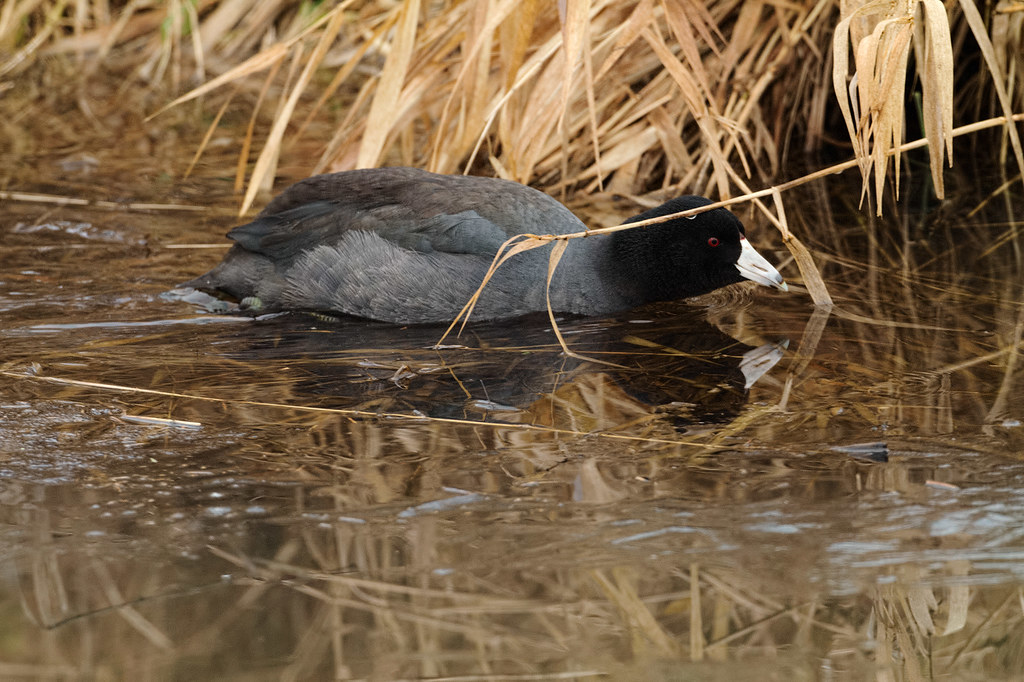
An American coot ducks under a plant stem as it swims down a narrow section of open water in a channel that has mostly frozen over with a thin layer of ice.
Blog
Dogwood Perch
Brothers
Black & Gray
Surprise Ending
I spent New Year’s Eve at Ridgefield from sunrise to sunset. It was sunny and cold throughout the day and the shallower ponds had partially frozen. Near the end of the day I was parked near the start of the auto tour so it would be easy to leave before the gate closed. A great egret was hunting bullfrogs in the shallow channel beside the road and I expected it would be my last wildlife sighting of the year. Not a bad way to end the year.
But then I heard a loud crack in the ice and looked down to see that a river otter had punched though the ice to come up for air. It didn’t stay long before submerging and swimming out of sight, but it made me laugh, Ridgefield giving me one last surprise to close out the year.
The egret had moved on, the otter had swum away, so I was about to pack up my camera for the trip home when a couple of hooded mergansers swam by in open water beside the ice, beautiful in the last light of the day. My goodness but the refuge was putting on a display. After a quick scan to make sure bigfoot wasn’t hiding in the bushes, I packed up my camera and headed home.
Rear-ended
On the Hunt
There’s a spot in Long Lake where floating branches accumulate at the edge of the lake by a culvert. Both red-winged blackbirds (like this female holding what I presume is an insect larva) and song sparrows frequently hunt in this little section, looking for insects hidden in the plants and mud. The blackbird searches with its beak, as shown below, while the sparrow typically uses its feet. I’ve spent hours watching them on the hunt, as its also a good spot to watch mergansers hunt for fish just a bit further out, and a couple of times a river otter has swum up gone through the culvert to the other side of the road.
A Chipmunk in Paradise
Mammals vs. Dinosaurs
I’ve met people who think it preposterous that birds descended from dinosaurs, a theory that dates back to the 19th century and the discovery of an Archaeopteryx fossil, as they think of birds as being small and cheerful. They might change their minds if they spent some time watching an egret hunt for voles.
As I’ve photographed birds over the years I was struck by how many of the feathers on a bird’s body aren’t actually used for flight. I began to wonder which came first, feathers for flight or feathers in general? This article by Luis Chiappe on dinosaurs and birds gives the answer (spoiler alert: it’s not flight). I’ve only started reading the article but it’s written in plain language and has a lot of information (and importantly, references) on the link between dinosaurs and birds, and how most paleontologists believe that some dinosaur species survived and evolved into the birds we know and love today.
I suppose it’s all splitting hairs to this vole, within seconds of being swallowed on a rainy January afternoon. I sometimes shoot hunting egrets and herons and bitterns with my biggest lens, to show that one life is ending in order for another to continue, and sadly I’ve only ever been able to photograph these voles in the last seconds of their short lives. I keep hoping one day to get a photograph of a vole just sitting in a meadow but for some reason they don’t stay above ground very long.
Aubergine
I ordered Tom Bihn’s Aeronaut 45 in December with an Aubergine exterior and Wasabi interior. I was hoping to first use it on a trip to the Hoh Rain Forest, as I’m determined to finally visit when it’s actually raining, but life intervened. I’m still hoping to get up there this spring, but in the meantime I took a macro shot of the ballistic nylon fabric.