Two young marmots play in a mountain meadow as one of the adults looks on. We came across this colony in the early fall beside the Skyline Trail in Mount Rainier. You can see how chubby even the youngsters are at this time of the year as they prepare to hibernate through the long winter on the mountain. Despite being wrapped in waddling clothes, the marmots move with surprising speed when they want to, bursting across the talus fields with a speed that belies their bellies.
Category: Mammals
Synchronized Preening
Early one morning on Mother’s Day, I stopped along the auto tour at Ridgefield to watch wood ducks in a quiet channel. A sudden dark form in the water caught my attention, I hoped for a beaver but knew it was more likely a nutria, the most commonly seen of the large rodents. Muskrat frequent the area as well but it was too large to be a muskrat.
My first impression from the size and shape of the head was that it probably was a beaver. There was little doubt left when its large, round form emerged onto the far bank, and no doubt remained when its broad flat tail finally came out of the water. I was feeling pretty blessed, watching the beaver preening, when a second dark shape swam onto the scene. To my delight, a smaller beaver climbed up onto the bank next to the large one and began grooming itself before finally snuggling up to the larger beaver.
Upon getting home, I learned that there is no difference in size between beaver sexes, but that the young often stay with the parents for the first couple of years, so this is most likely parent and child. I don’t know the sex of the older beaver, but given the day, I’d like to think they were mother and child.
Frosted Buffalo
Adaptable
Raccoons have adapted so well to the way that modern man has transformed the American landscape that it is estimated that there are more raccoons now than ever before. This one came into our backyard a few years ago to dine on the multitude of raspberries growing near the fence. After eating its fill, it crawled up to nap on a nearby carport.
Bottom of the Pecking Order
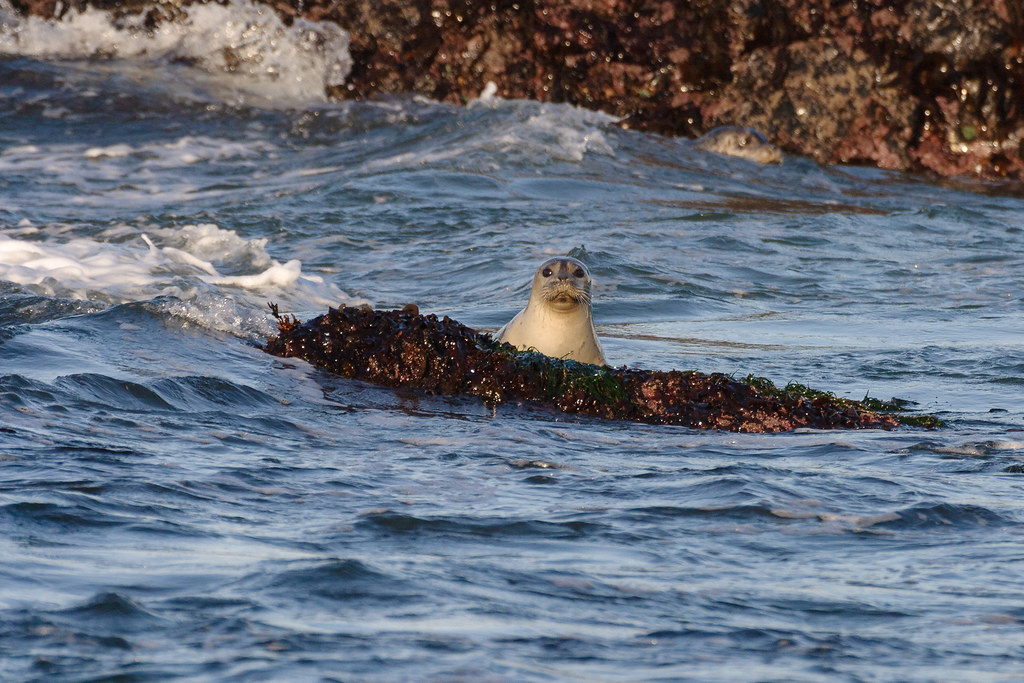
This young seal was at the bottom of the pecking order when it came to places to perch and rest, occupying the first place to get covered by the sea as the tide rolled in. This particular wave though didn’t dislodge the little one and it was able to hold its position until the rock was submerged. When I was growing up we had our own bottom rung: the dreaded middle seat in the station wagon, the one with the big transmission hump in the floor where your legs should have been.
Big Yawn
Wave Goodbye
Sign of Sanity
While visiting Olympic National Park in 2004, my wife and I escaped the crowds of the Hall of Mosses Trail and walked down the lovely Hoh River Trail where we met this Douglas’ squirrel. When you spend time photographing something as common as a squirrel at a place as special as the Hoh Rain Forest, some of the other tourists look at you with a mixture of curiosity and pity, as though you’re either slightly mad or slightly a moron.
Both of which might be true, but I enjoy photographing squirrels and do it no matter where I am, especially species like this one that I see less often. While the squirrels I see in my yard in the city are invaders from the east, the Douglas’ squirrel is one of the native tree squirrels in the Northwest.
Sunset on the Rocks
When I visited Mount Rainier National Park in the fall of 2008, I saw more pikas on the the Pinnacle Peak Trail than I’d ever seen on a single trail before. It would only be a slight exaggeration to say I saw more pikas on that hike than I had seen in my entire life until then. They weren’t all close to the trail, the talus fields are extensive and often lead far from the trail, but some of them were close enough for pictures, including this pika that popped out of a rock wall near sunset.
What Are Your Intentions?
Bison are the easiest of the big mammals to see in most of Yellowstone as they sometimes hang out in large groups near the road. They generally leave people alone but seem so docile that inevitably someone will get too close and end up getting hurt. It’s not so easy to underestimate them on the trails, however, where it’s hard to ignore their size and speed. And of course the horns. You are in their domain and there is no car to retreat to.
This was one of a group of bulls that was coming in my direction on the Storm Point Trail. While you are supposed to stay on the trails in Yellowstone, I decided to let the bulls have the right-of-way and stepped into the meadow. However, they soon veered off the trail themselves to go for a romp in the wallows so I was able to safely continue down the trail.